Birds, Leps, Observations & Generalities - the images and ramblings of Mark Skevington. Sometimes.
Showing posts with label Mothing Memories. Show all posts

Sunday, 24 April 2022

RIP APR

For 22 years, I have recorded and enjoyed moths with Adrian Russell. He was the VC55 County Lepidoptera Recorder when I very first got interested, a role that he effectively took on from c1992 to try and give some structure and organisation to recording in VC55. I first corresponded with him in late 1999 with some moth records from my garden, and from early 2000 we exchanged many phone calls, 1000s (literally) of e-mails and enjoyed many nights out mothing along with the occasional social. We'd not done anywhere near as much out in the field in the last few years due to health issues and covid restrictions, but we did get in a couple of nights last year and a joint leafmining foray in mid-November.

Adrian was very helpful to me in the early days with his time, ID help, access to sites and generally being a model County Recorder. Over the years as my experience and knowledge grew, particularly on micros, Adrian was happy to ask me for help and guidance and over the last few years I've been helping reduce his workload by giving ID help to other recorders and helping with record verification. I've held the emergency back-up files for the VC55 dataset and masses of associated files for the last few years, with the last update coming through as recently as 05/04/2022.

This weekend I'm a bit lost and numb, saddened and shocked by the news that Adrian died on Friday after being in hospital all week. I knew about his illness, knew his prognosis and knew that he was unlikely to see out the year, but no-one could have foreseen such a sudden deterioration in his health.

Adrian had been working for a number of years on a book covering the full history of Lepidopteran recording in VC55 along with the status and details on all moth and butterfly species. It was a project that he'd essentially been researching for and thinking about for years and it is a shame he never got to finish it or see it published in the way he intended.

We shared many nights around a light, many early morning surprises going through traps with camping stove coffee and bacon butties, and added many species and dots to the VC55 dataset in the process. It will be very strange indeed running traps out and about without Adrian around, either sharing the experience or being the first to know of any exciting news.

A typical early morning - which of the x17 traps to empty first ....

Monday, 24 July 2017

Nice Pear

All this recent banana-ing lark in the garden reminded me of an unplanned but novel event some years ago, and I set about trying to find a couple of photos I knew I had somewhere on an old external hard-drive. Anyway, it was way back in 30th June 2001 and a group of us were running a light over a sheet in Martinshaw Wood in Leics. This is back when running a tripod and sheet for a few hours was about as hard-core as it got for us, before the days of running a stupid number of traps over night.

One of the group (I'm sure not me) had brought along a couple of pears, of all things, for a snack. After polishing off the first one the core was accidentally dropped and ended up on the sheet. Being blokes, no one bothered to pick it up and chuck it into the undergrowth .... which turned out to be a good thing.

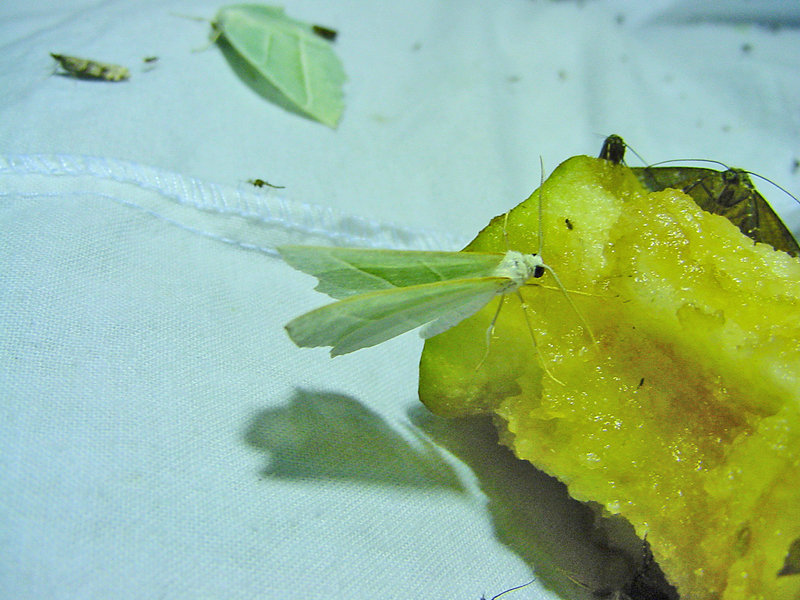
Quite soon after the fruity core hit the sheet, one or two moths gravitated towards it. Before long we were watching out for moths on the pear rather than round the light. I'm sure none of the moths were primarily attracted by the pear, but it certainly got their interest once they were on the sheet. The other pear was duly half-eaten and dropped to add to the spectacle.

Here's some crappy old digital photos under MV light at night photoshopped back to some semblance of life showing Mottled Beauty, Tawny-barred Angle, Light Emerald, Large Fuit-tree Tortrix, Barred Fruit-tree Tortrix, Green Oak Tortrix, Ingrailed Clay and Plain Golden Y on it. There were probably others, but you can't expect me to remember everything that happened 16 years ago unless there's a photo .........


Friday, 13 May 2011

Mainly Monochrome Mothing Memory

Garden mothing over the last few days has been completely unremarkable with low numbers and nothing exciting. I can hardly be arsed to summarise it all. Instead, whilst looking through some old photos, I found a few more from a great trip out and about back in early June 2006 with Keith Tailby. We started with an overnighter at Hazelborough Forest in Northants, headed down to Dorset for both Bee Hawk-moths and an overnighter at Durlston CP, then dropped into Shapwick Heath on the way back home. Some great moths enjoyed, including these .....

Argent and Sable

Mullein Wave

Light Feathered Rustic

Pretty Chalk Carpet

Tuesday, 5 April 2011

Abberations and forms

Dean's great photo of a Water Carpet f.porrittii this evening got me thinking about the various forms and abberations of moths that I've seen over the years. Not that many to be honest, once you exclude the species that are prone to wide variation within the general population. Here's a few that I managed to find old photos of without trawling too deeply through the badly archived archives ....

Blood-vein, Enderby Quarry 13th June 2004
This one is referable to f. nigra, and as far as I can gather it's pretty rare.

Dotted Border, Whetstone 17th April 2003
This is referable to f. fuscata, a fairly common form, but the only one I remember seeing that was this dark.

Lime Hawk-moth, Wicken Fen 18th May 2002
This is referable to f. brunnea, again the only one I remember seeing.

Brimstone Moth, Luffenham Heath Golf Course 14th June 2003
No idea if this is a named form, or a genuinely abberant individual, but certainly the only one I've ever seen.

Saturday, 3 April 2010

Top Mothing Nights

Following one of Ben's comments, I had a trawl back through my records to see what the top nights have been in my garden traps in terms of both numbers of species and numbers of individuals.

I've run a 125W MV trap of one sort or another since 2000, and in 2007 I also started running an 80W actinic. The following are the top nights so far:


I think I'll need to retain a few micros for dissection to beat 112 species in one night in the garden, whilst the 615 individuals in one night is largely down to the late summer noctuids (especially Large Yellow Underwing which seems to really go for the actinic).

I've also looked back at out of garden trapping, both solo efforts and joint sessions with others, and the best out of county nights (though these are all at Wicken Fen despite trapping at Dungeness, Gibraltar Point, Portland, Durlston, Hazleborough Wood and Old Sulehay).


6438 of 276 species is going to take some beating anywhere, and 3192 of 233 species from just 6 traps is also highly notable.

Monday, 22 February 2010

Mothing Memories - Getting the Goat

After the photos I uploaded a few days ago, I've been looking for a batch from a follow-up visit to Wicken Fen in May 2003. Finally found them tonight, and in particular one species that literally had us exclaiming expletives. Sitting on the deck next to one of the traps was a massive, unexpected and fecking awesome Goat Moth - superb moth and one that I would love to see again.

Saturday, 20 February 2010

Mothing Memories, Wicken Fen 18/05/2001

Wicken Fen is one of the most famous reserves in Britain, and it is certainly the oldest. Even before the National Trust bought the first parts in 1899, the area was well known to entomologists and had been visited by recorders and collectors since at least the early 19th Century. The reserve is host to a huge range of species, with well over 1000 moth species recorded there. Over the years, hundreds of thousands of visitors have walked and enjoyed the reserve with its diverse habitats and iconic windpump.


My first visit to the reserve with moth traps was back in May 2002, along with Adrian Russell and Ron Follows. We had a great night, and highlights included my first Flame Wainscots and Reed Daggers, along with interesting pyralids like Nascia cilialis and Opsibotys fuscalis. That first visit also brought two species that I've not seen since - maybe another visit in early to mid-May is long overdue ....


Birch Mocha


A superb Small Chocolate-tip found resting on a grass stem by one of the traps.

Aside from the great moths, it was also good to find roosting dragonflies on reed stems in the first light like this one.


Four-spotted Chaser

Incidentally, I tried to post this last night with the post editor set to the 'new improved' version. I eventually gave up trying to get the images and text properly justified, aligned, positioned etc - what is the trick?

Wednesday, 28 October 2009

Mothing Memories, Tresco October 2001

Too dark to do anything useful when I get home from work, and I've left the garden traps off despite the mild conditions as I have no time to do them in the morning this week. So, to fill the gap here are a few old shots of mothing memories. In fact, they are so old that the resolution is pretty crap and I can't make the images much bigger than they appear on this page, so for a change don't even bother clicking on them. White-speck I was never an annual on Scillies - I genuinely felt that going every year would nullify the enjoyment. In 2001 (my last visit) I stayed at Borough Farm on Tresco for a week with Andy Mackay, Rob Fray and Richard Fray. My two previous visits to Scillies before this were in 1996 and 1999 - both awesome years for major rarities. However this year was the first that I was as much, and perhaps more, interested in the moths we might see. Humming-bird Hawk-moth Turned out to be pretty good, with the species taken in the week including a few fairly standard migrants that I was seeing for the first time like Humming-bird Hawk-moth, Four-spotted Footman, Pearly Underwing, Palpita vitrealis, Vestal and The Gem. Also good local species like White-speck, Shore Wainscot, Cypress Pug and Scillies subspecies of Feathered Ranunculus and Shuttle-shaped Dart. Palpita vitrealis The best night though was 12th October, when the catch included the following: Grass Webworm (Herpetogramma licarsisalis) Once the ID had been established (not straightfoward whilst on Scillies seeing as it is not featured in any British reference books) it was confirmed as only the second British record. This species is widespread in the Old World tropics including parts of central Africa and extending to Australia, Hong Kong, Malaysia and the Phillipines. It was first recorded in Europe in the Algarve region of Portugal in 1997, and rapidly colonised southern Spain and the rest of Portugal. The first British record was from the Isle of Wight in 1998. There have been a couple since our Tresco individual but still a very rare species here, a presumed immigrant from the adventive European population. Actually, only hours after potting this moth in the early morning I was out and about seeing Rose-breasted Grosbeak on St Martin's after an infamous boat-swap somwhere between Tresco and St Mary's, and then later a Paddyfield Warbler on St Mary's - what a major day! The rest of the week was less intense, though a drunken golf buggy joy-riding incident still makes me smile ....

Thursday, 3 September 2009

Mothing Memories - Portland 03/09/2005

Doubling up as an On This Day posting aswell, I've dug out a couple of shots from a poorly planned but eventually successful mothing trip to Portland on 03/09/2005 in the hope of migrants. I travelled down with Keith Tailby in the afternoon, and we entertained ourselves looking for Adonis Blue and the like before meeting up with Adrian Russell for the overnight trapping. We hadn't really thought about where exactly we could trap, and the conditions were not ideal with a very strong wind increasing from the south-east. Setting up traps on a coastal headland could have meant trying to reclaim them from the sea in the morning. After a bit of discussion, and a chat with Martin Cade from the Obs., we decided to set up at Tout Quarry - not ideal but likely to be sheltered, still a chance of picking up the odd migrant and also a chance of picking up one or two local specialities. By the time we decided to get some sleep, we'd already noted a few good species and the morning trawl through the 8 x 125W MV traps was surprisingly good with a total of 368 of 48 species. The main highlights for me (ticks, treats and migrants) were: Cochylis molliculana 1 Eudonia mercurella f.portlandica 1 Rusty-dot Pearl (Udea ferrugalis) 1 Mecyna asinalis 1 Rush Veneer (Nomophila noctuella) 1 Oncocera semirubella 3 Galium Carpet (Epirrhoe galiata) 1 Annulet (Charissa obscurata) 5 Yellow Belle (Semiaspilates ochrearia) 2 Convolvulus Hawk-moth (Agrius convolvuli) 1 Humming-bird Hawk-moth (Macroglossum stellatarum) 1 Dingy Footman (Eilema griseola) 1 Dark Sword-grass (Agrotis ipsilon) 2 White-point (Mythimna albipuncta) 7 Delicate (Mythimna vitellina) 1 Beautiful Gothic (Leucochlaena oditis) 7 Silver Y (Autographa gamma) 13 Beautiful Gothic - a smart resident RDB species recorded locally in the south-west The Delicate - a regular immigrant White-point - a regular immigrant and recently established colonist along the south coast

Sunday, 21 June 2009

Mothing Memories

I'm not much of a moth twitcher, but over the years I have made a few out of county trips that have produced superb moths that we are unlikely to see (or would be extremely rare) in VC55. Up until now, with one or two exceptions, I've not made much effort to publish any shots from these trips. So - every now and then I'll upload one here for the memory. First up is topical after comments on John's Blog - this is a Narrow-bordered Bee Hawk-moth. This was one of the prizes on a weekend trip down to Dorset with Keith Tailby. It was a blistering hot day and we'd already seen Broad-bordered Bee Hawk-moth at another site. After a couple of hours we'd got our eye in for these beauties zooming about, but really no chance of photography. Then on the way out of the site, we found a patch of milkwort where a couple of adults were nectaring in their typical hover and go style. Every now and then, one would sit on the flower for a few seconds giving a chance of getting a shot. Unfortunately I only got a shot of a slightly knackered one - but it was still bloody good!