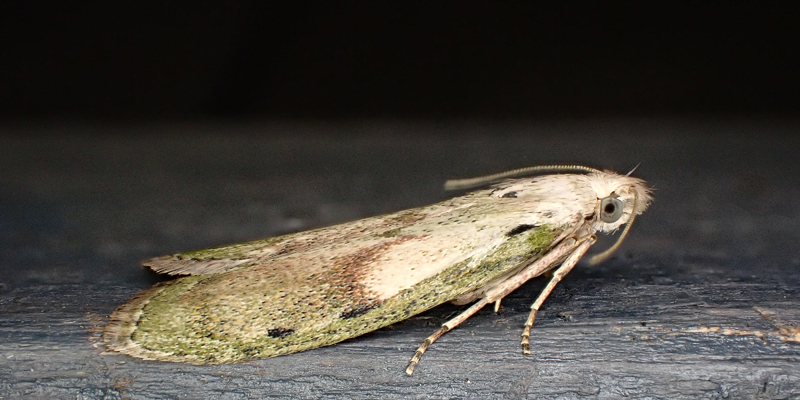
Last night, for the first time in well over a year thanks to [lack of] health etc, I ventured out with traps into woodland. I headed to Gisborne's Gorse, what is essentially mixed woodland within the Charnwood Lodge LRWT reserve. It's not 'real' woodland though, it was created in the late 19th century and part of it is more like a large-scale landscaped garden (there are a couple of old houses within the planted area). With such a long hiatus, it meant it was also the first time my 'new' car has been loaded up with traps. I've had it [Cupra Born EV] since Jan 2024, and the x3 traps, gennie and cable reels easily fitted in though I had folded the seats down just in case.
I had no great expectations for the night, although I had a couple of hoped-for species. I was only intending to run the traps for three hours or so - no point going overboard so early in the season.
And so it was that I lit up around 18:15, and ran the traps until packing the last one around 21:45. There were still moths coming in to the traps and it was still c7°C at that time, but I wasn't seeing any increasing diversity. I'm sure if I'd run for longer I would have had more Noctuids and maybe one or two more species, but the eventual total was 204 of 18sp. which is pretty fair for this early in March.
The couple of hoped-for species were Spring Usher which I'd not seen since 2012, and Yellow Horned that I'd not seen since 2013. Mottled Grey was also on the radar, though I was sure I was too early for that. No sign of any Spring Usher to the traps though, quite possibly too late this year. But Yellow Horned was bang on, I ended up with x51 of them and all box-fresh. Other highest counts were x42 March Moth and x36 Oak Beauty.
Given the abundance of fallen and felled wood alongside the track, I opted to photograph a few whilst out using the ever-reliable TG-6 and light guide. Smaller micros came home though, including a couple for dissection.
Yellow Horned
Engrailed
Satellite
Tortricodes alternella
Oak Beauty
March Moth
Pale Brindled Beauty
Brindled Pug
The only surprise as such was not the species, but the context. This female Dotted Border was sat on top of one of the traps basking in the glow of the light. The trap was not directly underneath the canopy, so the only way it could be there would be being 'flown in' whilst in-cop with a male or simply walking towards the light and crawling up. Given I only saw one male Dotted Border, and that it was in a different trap, the latter explanation seems more likely but of course it's a guess.
Dotted Border
Not too many micros aside from several T. alternella.
Ypsolopha ustella
Agonopterix ocellana
Acleris ferrugana/notana [dissection pending]
In compiling this post, I've reminded myself what an absolute pain in the arse it is to keep editing image sizes etc on Blogger. I think I'd realised this before and stuck to uploading at 'view size' only, but Bluesky seems to screw images up that are not already sized up. So going forward, it's going to be quicker and less of a pfaff to just save the images in two sizes. It will mean that anything on here will revert to what you see is what you get - no bigger image when you click on one.
I imagine one or two read the blog title and were delighted horrified that I might include a Coldplay track. Fear not.
Back in the day, after buying 'Skinner 2nd Ed', this was the second moth guide
that I bought ....
Apparently 'Pyralid' is derived from the Latin pyralis (which in turn appears
to be derived from the Greek pyr = fire). Pyralis was a fly fabled to have
lived in fire; perhaps an allusion to moths heading towards candles / torches?
Either way some of the species in this group are real crackers (though not
necessarily any of those featured here).
Amongst the micros, this group has always been generally sought after - perhaps
because accessible guides to other micro groups were limited at best. I used to
scrutinise any new Pyralid moths against this guide as I learnt the commoner
species, but I don't think I've actually opened my copy in the last ten years or
so.
Whilst it is a diverse group with a number of sub-families, there were all
Pyralidae back then. Not now; the group has been split into two families, Pyralidae and Crambidae. I've been happily snapping just about anything that
sits still by the trap for long enough over the last few weeks, whilst
looking for interesting non-leps, and realise I've ended up with a number of
photos of various common 'Pyralids' - a good opportunity to actually check
which family some of these are in and to overload your screen with far too many images for one blog post.
I'll start with species that are still within the Pyralidae:
Bee Moth
Gold Triangle
Endotricha flammealis
Phycita roborella
Acrobasis consociella
Acrobasis advenella
Euzophera pinguis
Homeosoma sinuella
Rhodophaea formosa
And the following are all within the Crambidae ....
Eudonia lacustrata
Eudonia mercurella
Chrysoteuchia culmella
Crambus pascuella
Agriphila straminella
Catoptria pinella
Water Veneer (female)
Small China-mark (male)
Small China-mark (female)
Ringed China-mark (male)
Ringed China-mark (female)
Pyrausta aurata
Anania perlucidalis
Udea prunalis
Mother of Pearl
It doesn't take a genius to see that there are moths within both families
that have similar shapes, eg why is a Gold Triangle a Pyralid and yet Udea
prunalis is a Crambid. I'm sure it makes sense genetically ....