As part of my recovery, my walks from home have gradually turned from short
shuffling ambles to longer strolls with a bit of pace. I've not really been
going anywhere with intent, it's just to stretch the legs and get some life
back into muscles. But of course it doesn't take long before longer walks turn
to walk-stop-walk sequences whilst looking at some shrubbery or other. And so
it is that I've picked up a few leafmines over the last few days - mostly
expected, but good to get the eye in for some proper effort later in the
month. Almost everything so far vacated.
These three all on crab apple:
Leucoptera malifoliella, Callisto denticulella and Bohemannia
pulverosella.
Stigmella aceris all over the place on both Field Maple as here, and also
on Norway Maple.
Etainia louisella on Field Maple keys. Actually this may be tenanted
but almost impossible to dissect out without destroying it.
Perhaps the only one that wasn't entirely expected, I found a load of
Phyllocnistis saligna mines on White Willow growing alongside the
Whetstone Brook between the local park and school. I've not walked along
there for a good few years, and realised that aside from these willows there
are some osiers and some healthy looking oaks that must have been planted
when the park was created c30years ago.
My walks have mainly been in the early evening after the sun has started to
dip, rather than in the full blown sunshine ....
It's been a busy and strange few weeks in a lot of ways, but not least the
fact that our youngest has buggered off to Bristol and is living in Uni digs
whilst starting his degree in (literally) rocket science. We nipped down to
check he was set-up okay a couple of weeks ago, but otherwise we're adjusting
to not having him here and having a room in the house that is not being used.
Our other two still live at home, but both work and both spend as much time
out with their partners and mates as at home. It's pretty much the first time
in 26 years that we've been able to do what we like, when we like, without
having to plan around one or other of the kids. We're not used to it and
haven't really capitalised on that yet!
The garden works are done and I've got a new bigger shed to sort out, along
with some drainage that works well and a level patio. A lot of work ahead to
actually make it look presentable and get some flowering plants in, and I've
got space at the bottom of the garden for composting. I also intend to create some
sort of raised pond - something for inverts, not amphibians!
One or two of you may well have noticed that I've not really mentioned or
shared anything about my 2021 square listing. I've not consciously given up,
but since July-ish it has pretty much drifted to the point that I may as well
have done. I've struggled to maintain enthusiasm and am short on energy whilst
being busy back at work. I also got well behind with transcribing garden light
trap lists to keep up to date. Through September I've barely had time to even
think about it. Yesterday I was in work tying up a few bits before I have some
time off in the coming week. On the way home, I took a detour along the lane -
the first time I've driven along there for a few week. The verges had been
mowed and the fields harvested, so not a lot to look at. But I did nosy around
at the trees and hedges for leafmines, finding quite a few on Ulmus, Norway
Maple, Field Maple, Hawthorn, Blackthorn and bramble.
A while ago, when I was expecting to be a bit more enthused and busy in the
field, a bought a cheap LED panel off of Amazon -
this one. I figured that for around a tenner it was worth a punt to backlight
leafmines with a bit more consistency and less pfaff than anything else I've
tried over the years. Powered from USB and A4 sized it is also very light and
portable. But - I obviously didn't read the blurb or look close enough at the
images. I thought it would just be a lit screen but it has a built in eye
protection plate - essentially when it is fully lit it looks like a load of
perforations. Still perfectly good for backlighting mines, but not so great
for photographing them. So I put it back in the box and forgot about until
yesterday evening when I had a bag full of mines. I gave it a go and,
actually, I'm quite happy with the results - albeit I need to edit the images
a little more in photoshop though it really is quick and easy for me to do
that.
Here's an example - a Blackthorn leaf with
Stigmella plagicolella mines. The first image is directly off of the
camera with no editing other than being re-sized. The second is the same image
with the background screen cut out and otherwise my usual editing (light
balance, sharpen a little and crop/resize).
I found quite a few Stigmella plagicolella mines on one particular Blackthorn -
it's about the only one that is set beck enough from the road that it doesn't
get quite so heavily flailed and so it has bigger leaves. Some were still
tenanted, and one leaf in particular had many mines - at least eight, probably
more.
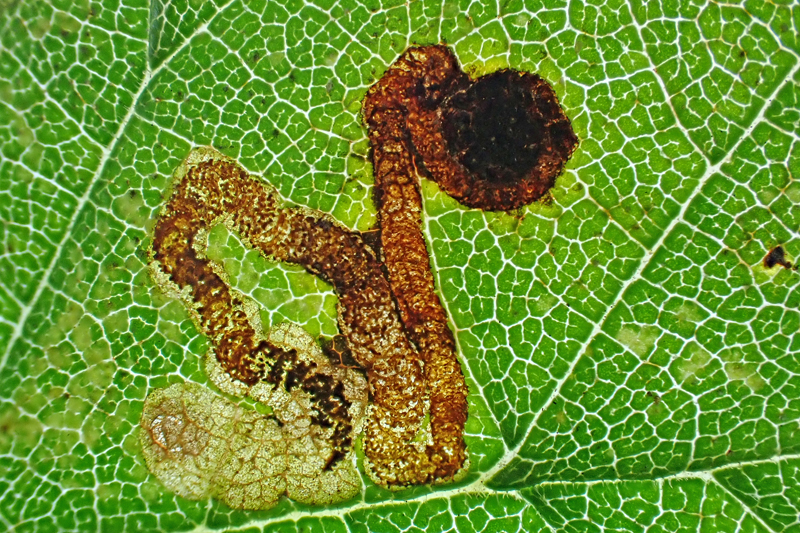
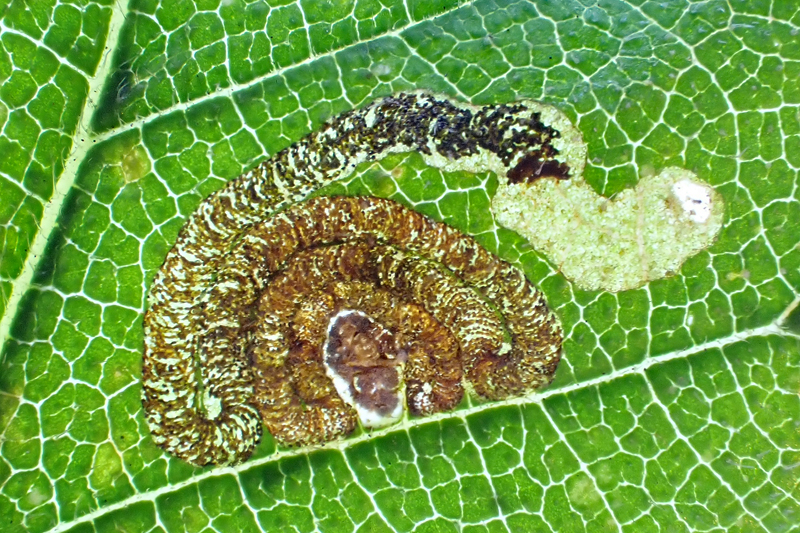
I was also pleased to find Stigmella aceris on both Field Maple (first
image) and Norway Maple (second and third image, alongside a
Phyllonorycter joannisi mine).
The Ulmus sp. mines were most numerous though, with many Stigmella mines -
some of which I could not work out but a few appeared a bit more distinct and
I sought a bit of confirmation on the leafminers FB group to help make my mind
up. The few tenanted mines were a bit more straightforward, with only Stigmella lemniscella
still active out of the two species I had. I also found a couple with the
distinct concentric circular start to the gallery.
Other mines were more consistent with Stigmella viscerella, showing a
winding 'gut-like' pattern to the gallery and a slightly different frass
pattern.
I found two different Phyllonorycter mines on Ulmus sp. - one a bit more
pinched than the other. Several had pupal cocoons within the mine which made
ID straightforward. The first mine has the dark stiff-looking pupal cocoon of
Phyllonorycter tristrigella, and the second is
Phyllonorycter schreberella with a neater and more delicate looking
spun cocoon
Also found on Ulmus was this Bucculatrix albedinella mine.
Other mines found were Stigmella aurella and Coptotriche marginea on bramble,
Phyllonorycter corylifoliella on hawthorn and Parornix finitimella on
Blackthorn. Given I was only looking for c45mins I though that was not a bad
effort. With some time in the week before we go away for a family break next
weekend, I'll be looking for other mines and perhaps a few galls.
The garden trap has been on for a couple of nights, so I will have a few late
autumn moths to share at some point too.
Hmm. That felt quite good getting that done and ready to post - perhaps the
post-summer doldrums are over and things are getting better.
Nipped out the afternoon for a walk along another disused railway line not too
far from home, this one running between Enderby (not far from the Quarry I
used to moth-trap regularly) and Narborough. It's called the Whistle Way,
apparently. I completely ignored Government advise about gathering in social
groups of six and opted for an anti-social group of one.
My intent was to look for leaf mines. In particular, I was following up a
recent leaf mine record of Incurvaria pectinea which is extremely rare in VC55
(no records since c1955 as far as I know, despite an abundance of all
potential foodplants inc. Hazel and active leaf mine recording for decades). I
had absolutely no joy on that score, and interestingly there was very little
Hazel and Birch present. There was however an abundance of other trees and
shrubs, including Field Maple, Elder, hawthorn, Prunus spp., Rosa spp., oak
and Ash. Plenty to look at then. In particular, I had a good look at the Field
Maple, looking for one that had so far eluded me despite searching over
the last few weeks. And scored!
Stigmella aceris, avec green larva and greenish frass darkening in
older part of mine
I also found a lot of the same mine on Elder, a messy looking blotch that
appeared to be dipteran. It was.
Liriomyza amoena
Another dipteran mine was not new, this one on White Dead-nettle ....
Amauromyza labiatarum
Whilst looking for leaf mines, there is always a chance of finding more
obvious larvae ....
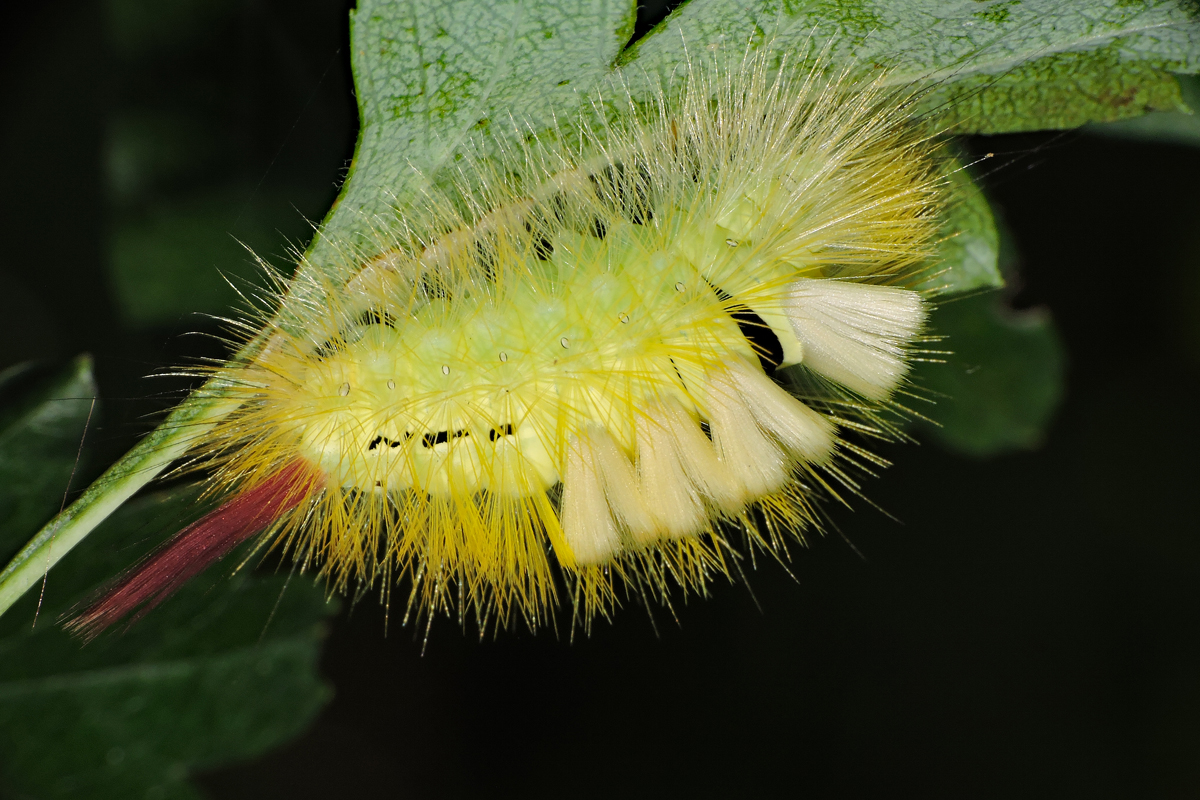
Pale Tussock, inconspicuously bright yellow, tufty and red-tailed