Birds, Leps, Observations & Generalities - the images and ramblings of Mark Skevington. Sometimes.
Showing posts with label Narycia duplicella. Show all posts

Sunday, 11 April 2021

Rushing

Yesterday I followed up on a tip-off from Graham Finch and headed out to look for some larval life that would provide a lepidopteran tick. What I didn't realise until checking afterwards was that I was getting a vascular plant tick in the process. I headed out to Kinchley Lane that runs along the side of Swithland Reservoir, the site that I usually go and look for Psychidae early in the year.


See all that green stuff on the bank around the birch trees and at the base of the wall, well it's not just grass - it's Great Wood-rush. Clearly I have seen this many times whilst on that lane, but I've never taken any notice of it and it wasn't on my list. Here's some shots of the general appearance, hairy-edged wide leaves (for a wood-rush) and flower spike ....


Anyway, what I was looking for on this plant was leaf mines like this one ....


A creased blister causing the leaf to fold in on itself on older mines. I found a few, and collected what I thought was two tenanted mines and one old vacated mine ....
It was then that I noticed that what I thought was an older mine was going in the opposite direction to the others: this one had a frass collection nearer to the tip of the leaf with the mine heading basally. And, despite appearances all three mines were tenanted.


I needed to open the mines to check the larva to be sure on the ID. This larva was clearly not impressed as it constantly shuffled up and down the leaf so I had to whack up the ISO to get a clear enough shot.


So, mines on Great Wood-rush tenanted by a greenish larva with a brown head and prothoracic plate which is darker at the outer margins (as opposed to whitish-grey with black prothoracic plate) confirm this is Elachista regificella (and not Elachista gleichenella which may also mine this plant). Sweet. Highly unlikely that I'll get one reared through but it has to be worth sweeping the plants in late June - mid July. Great Wood-rush seems to be localised in VC55, mainly around the Charnwood area including Swithland Wood.

Whilst I was there I had a quick look for Psychidae. Every year there seem to be fewer cases, or perhaps my eyesight is getting crapper.


A couple of Dahlica sp. above (probably D. lichenella based on size and lack of obvious insect fragments), Narycia duplicella below.


I also found a few Dyseriocrania subpurpurella loafing about including this pair in-cop.


And there were loads of Alder Flies, none of which I bothered collecting to check exactly which one.


It was pretty nippy whilst I was out and certainly not inspiring enough to spend a lot of time looking around. I headed to Ulverscroft to have another look at the Infucitinea argentimaculella colony, and found absolutely loads of tubes. None that I collected last year were successful, so I think his year I'll go and collect a few in late June by which time they'll have pupated.


Monday, 8 February 2021

Change

Well I've not done a lot that's blog worthy; the last time I used the camera was last Wednesday, and after that I've had a few days of feeling a bit weary and not up to much. In that time though, I have fitted new integrated fridge and freezer units; both were well past their shelf life (c16yrs) and ready for change, though still working fine up until the fridge blipped off on Tuesday. By the time I'd swapped the fuse and confirmed that was not the issue, looked for and ordered new units, it had a miraculous resurrection but I doubt it would have lasted much longer.

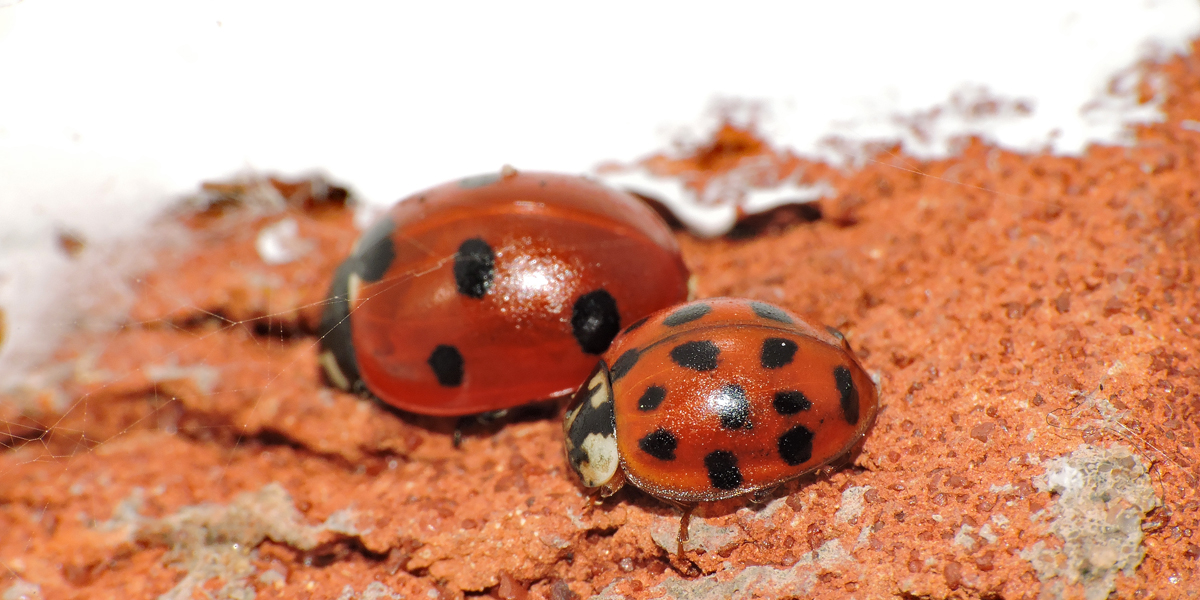
The camera use on Weds was to capture a couple more bits from the front garden. I found a much more straightforward Narycia duplicella on the cherry tree trunk, and a small Harlequin Beetle sitting it out tucked up with a 7-Spot at the top of a window frame.


The only other new square record was a pair of Canada Geese honking as they headed directly over the garden last week whilst I nipped out to top up the feeders. Again. The Goldfinches are costing me a fortune this year despite buying sunflower hearts in bulk.

Whilst I'm not seeing much, I'm catching up on some overdue PC maintenance tasks - prompted by Stewart's issue with his electricity provider overloading the mains circuit and frazzling his PC. I've got not far off 500Gb worth of photos built up over the years of family, places and of course wildlife. It's a resource that is constantly growing, and I do not trust cloud-based services etc. So, I've always relied on physical back-ups, and as the total file-size has grown (and therefore the impact of any loss increases) I also back-up my back-up. The hard-drive on the PC is more than sizeable enough to be the main host for all of my files, but I hold a copy of all the photos, music, MapMate records, other key files etc on a 2Tb flash drive and a separate copy on another 1Tb flash drive that I keep in a lockable fire-proof case. As I go through the year, I am adding files and tidying up the PC host, and then on a six-month rotation I back up each flash drive. I should do it more regularly but it takes a while. Worst case scenario should be that I've lost the last six months worth of photos - although at least anything that it useable will have featured on this blog, social media or family What'sApp etc. However I forgot during the summer and so I've started backing up both drives again as I write.

Change is inevitable in life, and even things that seem to have been a long-standing constant have to move on eventually. Tomorrow, Nichola's parents will be leaving their house in Guineaford and they're moving to a more sensibly sized and manageable property as they move into the second half of their 70s. The house they are leaving has been their home for c28 years, the longest they'd lived anywhere, and all three of our kids and their cousins have grown up knowing nothing but this house.


There are masses of great family memories, and it's been a shame that thanks to Covid etc we've not been able to visit them since Dec 2019. The house had a great rural garden and I've seen some great wildlife in it over the years. They're staying in North Devon and won't be too far away though, and whilst one door literally closes another opens. The new house will be closer to the estuary and Northam Burrows.

Here's a couple of moths I've only ever seen whilst garden trapping at the Guineaford house:

Brussels Lace

Nut-tree Tussock

The only other change of note, I've finally decided to order an Olympus TG-6 camera given that all I hear are good reviews and see good results. I was thinking of waiting to see if a new TG was coming out, but the noises seem to be more along the lines of the range coming to the end of line. My trusty P600 won't last much longer, although it's behaved for most of the year after the wobble last spring, and the P950 has proven to be too unwieldly for proper macro work (whilst being great for big zoom birding, dragonflies and similar). This blog is already a mish-mash of photographic sources so aside from some early experiments and comments (when I've got anything to point it at) I won't be making a point of highlighting which camera I've used for what shots. Likely the TG-6 will be mainly used in the field and I'll keep the P600 going as long as possible for indoor macro work on moths and similar.

I'm feeling up to more this week, but the weather has turned baltic to say the least. I'll be busy with work tomorrow, but hopefully Weds should be a crisp and dry day albeit remaining blisteringly cold, so I'll be planning to get back out then.

Friday, 6 March 2020

A Tenuous Case

I made use of a couple of free hours this afternoon. First off, I headed to Swithland Reservoir in glorious sunshine. I'd only just got out of the car when I noticed a few ducks close to the dam by the overflow, including two of my favourite species beginning with G ....


Gadwalls were preening and having a drink in between bouts of courtship ...

No such luck for this lone drake Goldeneye.

After grabbing a few snaps, I set about my main purpose. Staring at walls. It didn't take long to find the expected Psychidae.

Luffia lapidella f. ferchaultella

Dahlica sp. - found a good number of cases in a slightly different section of the boundary wall to where I usually look. All looked to be D. lichenella, no potential D. triquetrella.


I noticed one moving about, surprisingly. They overwinter as full-fed larvae and should be pupating by now. When I got my hand lens out to have a good look at this one I noticed something else very close by .....

Bristly Millipede - never ceases to amaze me how these are invisible when you are actually looking for them.

Whilst I was enjoying these wall-dwellers, they were not what I was actually looking for. News came through during the week that Keith Tailby and Mark Hammond had found putative silk-tube cases of Infurcitinea argentimaculella. The photos seemed compelling, if a little inconspicuous. They'd been found at Ulverscroft and along the Swithland Res walls, but I was seeing nothing. After a quick call to Keith, I decided to head over to Ulverscoft and try there.


I was soon looking at a much more promising habitat, with the dry stone wall covered in a powdery blue-grey lichen (Lepraria sp.). If you think looking for larval cases of Psychidae is tenuous, you ought to try this .....


This is likely to overwinter as a small larva, but should be starting to become active again in spring, so it seems likely that bigger cases are old and vacated. I've collected a couple to have a look at, but definitely this is one to make an effort to return to in a couple of months. With lichens generally doing better now, and with eg the spread of lichen-feeding footmen spp., seems likely that this has also done well in the last decade or so and could well be wide-spread. After all, even when it's on your radar (which it wasn't) it is not exactly jumping out at you!

Just before getting back in the car, I had a quick look at the outer wall and quickly found more Psychids.


Narycia duplicella

Sunday, 1 April 2018

Larval Life

A bit of a catch up from the last week or so. No garden trapping as the weather has been absolute pants, and I had a long weekend away with family to celebrate my wife's big birthday. Around that, and in lieu of any trap action, I've been looking for larval life.

After the long weekend, I had the Monday off with Nichola and we headed out to Swithland Res and Bradgate Park for some fresh air in relatively decent spring weather. Whilst walking about, I had a quick look at the dry-stone walls and found plenty of psychidae and a couple of larvae ...

Luffia ferchaultella, Bradgate Park 26/03/2018

Narycia duplicella, Bradgate Park 26/03/2018

Dahlica lichenella, Swithland Res 26/03/2018

Taleporia tubulosa (with Bristly Millipede getting in on the action)
Swithland Res 26/03/2018

Psyche casta, Bradgate Park 26/03/2018

Common Footman, Bradgate Park 26/03/2018

Believe this is a Large White chrysalis, Swithland Res 26/03/2018

Believe this is a Green-veined White chrysalis, Swithland Res 26/03/2018

Back on 15/03/2018 I found a few noctuid larvae in the garden. Amongst them was an early-instar that I didn't recognise at all with obvious setae that seemed odd for a noctuid. Anyway I've been feeding it up on dandelion etc and it is growing, but it is the most docile larvae I've ever reared. I've not seen it crawl about at all, and it just curls up into a tight coil if disturbed. I think I've sussed what it may be but I'm going to have to try and rear to adult to confirm.

Believe this is a Hoplodrina spp, either an Uncertain or a Rustic.


I've also made an earlier start than last year on looking for leaf-miners. I checked out a known Holm Oak just a few miles down the road at Sapcote on 30/03/2018 hoping to fine a few mines. Hadn't realised how easy it would be - the whole tree was heavily infested and it was obvious as I passed the tree before parking up.

Pretty much every leaf had numerous mines with at least two species involved


Ectoedemia heringella, vacated mines

Ectoedemia heringella, tenanted mines

Ectoedemia heringella tenanted and vacated mines, and Phyllonorycter messaniella vacated mine

Phyllonorycter messaniella vacated mine, upperside

Phyllonorycter messaniella vacated mine, underside