Birds, Leps, Observations & Generalities - the images and ramblings of Mark Skevington. Sometimes.
Showing posts with label Ptycholomoides aeriferanus. Show all posts

Saturday, 8 July 2017

Smart Trapticks

I'll be making an effort to remember to have the camera on hand from now on whilst I empty the moths traps through the summer. The traps are starting to pull in a few bugs and other bits and quite often I get better shots of them on the eggboxes than afterwards!

Very early in the morning on Friday whilst emptying the traps, I noted three mirid bugs. All looked familiar but I had no idea of a name for any of them. Subsequent checking of the photos revealed that two of them were actually a male and female of the same species and complete British tick for me - so either I've seen but ignored them in the past (possible) or they were just superficially similar to one I have seen. Either way, just as well I bothered grabbing the camera!

Stenotus binotatus - male

Stenotus binotatus - female

The other was one that I've recorded from the garden traps before:

Stenodema calcarata

There was also a chunky leafhopper that I see in the traps quite frequently ...

Iassus lanio

And to cap all that, there was also a small weevil that looked interesting enough to pot up (which was just as well as the photos I took were actually complete crap!). It looks like this is going to be another British tick, and more importantly another good beetle record for VC55 with only three previous and none for c21 years.

Dorytomus ictor

I'll round off with a few moths that have been left to one side during the photo catch-up - the decks are now clear for whatever tonight and the week ahead brings.

Possible Argyresthia glabratella - pending gen det
post-script - got this one completely wrong, confirmed as Tineola bisselliella by gen. det. which is a completely new British Tick for me!

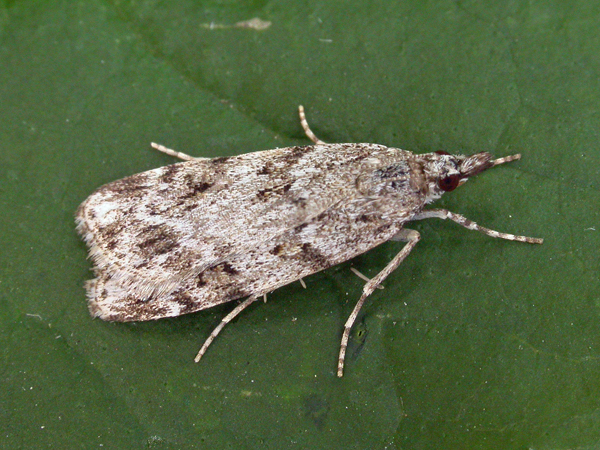
Ptycholomiodes aeriferanus

Chrysoteuchia culmella

Catoptria falsella

Small Fan-footed Wave

Monday, 8 August 2011

Some Moths, and Memory Lapse

First up, here's the summary from the last garden trap outing on 05/08 - haven't bothered since for various reason including apathy, fatigue and uninspiring conditions.

Total catch 291 of 71sp.
(125W MV 145 of 50, 22W/18W Synergetic/CFL combo 146 of 46)


First for year in garden:
0819 Scrobipalpa costella 1
2134 Square-spot Rustic (Xestia xanthographa) 1


Highest counts:
2111 Lesser Broad-bordered Yellow Underwing (Noctua janthe) 37
2343x Common Rustic agg. (Mesapamea secalis agg.) 37
1304 Agriphila straminella 17
1713 Riband Wave (Idaea aversata) 16
2109 Lesser Yellow Underwing (Noctua comes) 13
2321 Dark Arches (Apamea monoglypha) 13
1331 Water Veneer (Acentria ephemerella) 11
1036 Acleris forsskaleana 10
1937 Willow Beauty (Peribatodes rhomboidaria) 10

Best of the rest:
0987 Ptycholomoides aeriferanus 1
1236 Pammene fasciana 1
1497 Amblyptilia acanthadactyla 3
1738 Common Carpet (Epirrhoe alternata) 5
1777 July Highflyer (Hydriomena furcata) 1
1825 Lime-speck Pug (Eupithecia centaureata) 2
1835 White-spotted Pug (Eupithecia tripunctaria) 1
1838 Tawny Speckled Pug (Eupithecia icterata subfulvata) 1
1883 Yellow-barred Brindle (Acasis viretata) 1
1981 Poplar Hawk-moth (Laothoe populi) 1
2044 Dingy Footman (Eilema griseola) 1
2047 Scarce Footman (Eilema complana) 1
2112 Least Yellow Underwing (Noctua interjecta caliginosa) 1
2293 Marbled Beauty (Cryphia domestica) 2
2384 Vine's Rustic (Hoplodrina ambigua) 1
2441 Silver Y (Autographa gamma) 1

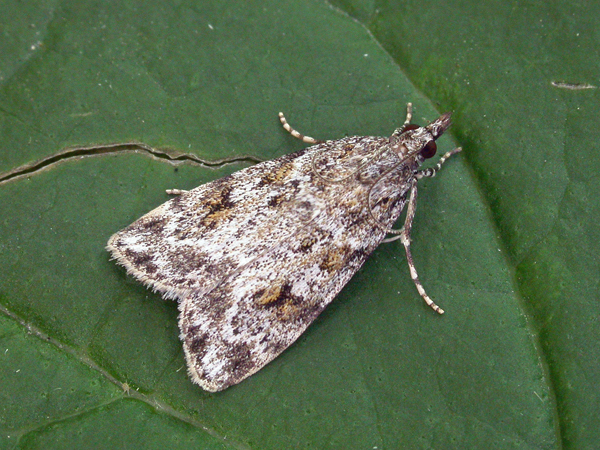
Ptycholomoides aeriferanus

Epinotia nisella

Silver Y, very small (about half normal side) and therefore a presumed f. gammina
Note how I have measured it with a very precise instrument calibrated to National Standards in a thermally conditioned UKAS accredited lab ...... no, it's not a childs ruler .... how very dare you

Silver Y

Lime-speck Pug


Now then, every year we I seem to make subjective comments based on nothing more than perception that it is a fantastic, good, bad, shite month/year for moths in the garden. This happens especially in July - mainly because I do expect to have a lengthy task every morning emptying the masses from the egg trays. This year, my perception was that it was a relatively poor year. Now the month is gone, and the records are up to date, I decided to check just how bad it was.

A key constraint for me in comparing one year to the next is that I do not run the garden traps in any sort of regimented frequency. So, the number of trap nights varies both dependant on the prevailing conditions and my availability. Ironically, in a good year I am more likely to be out and about at every opportunity and therefore not running the garden traps. I also have parental duties and family committments after mid-July when the schools shut up shop for the summer. The other factor is that prior to late summer 2007 I ran a single 125W MV trap. Since then, I have tended to run two traps - a 125W MV and some additional actinic, combo or other to compliment it. This means (in theory) that I have increased the potential for attracting greater species diversity and higher numbers. So, I started gathering the data to compare year to year based on the average number of species and individuals rather than the totals outright. I plotted the data for 2000 but left it out from the averaging as I am sure I ignored a lot of things that I couldn't identify at that point.

A quick check to see how bad 2011 was .....

Oh .... Seems I had completely forgotten that 2007 was in fact so poor that opportunities to run the garden traps in between rainy spells were few and far between indeed. I checked back and found e-mail correspondence remarking about how completely rubbish and depressing July 2007 was. In fact the mothing in July that year was so bad that I had to omit it from the averaging to avoid skewing the data too much.

Digging further, I found that 2011 was indeed poorer than 2010 for species, though not as bad as I thought for numbers. I also found that 2010 was actually a good year (in fact the best to date). This then means that 2011 wasn't that bad after all. So much for the perception.

Here are some charts for you to glance at, scratch your head and wonder WTF I am doing wasting my time on such trivial nonsense. First, the comparison of the averages and then the outright totals so you can see what a difference it makes to the analysis (such as in 2005, when I was unable to trap as frequently hence reduced overall totals but good averages). I use the term analysis, but what I actually mean is unscientific and statistically unsound comparative wibble. I have split the multi-year average line to account for the change in number of traps, my inexperience in 2000 and the utter shiteness that was 2007.


Friday, 24 June 2011

From The Garden Trap - 22/06/2011

Before I give the summary from garden trapping on Wednesday night, a bit of a landmark in terms of the garden list has been reached. ish. Back on 16th Jan I was speculating on which new species might turn up in the garden, and also on whether the garden list would top 600 during 2011. Before Wednedsay night, the garden list comprised 297 Macros, 298 Micros and an additional 4 micros for gen det confirmation of the provisional ID - all of which are certainly new species for the garden. That gives a grand total of 599 species unless my mental maths needs calibrating. So, the Heart and Club will (eventually) be the 600th moth species for the garden. Hurrah. And it doesn't stop there as there is another new micro and another one for gen det as you'll see shortly.

Also worth noting that back on 16th Jan the list stood at 296 macros and 293 micros (589 species). I somewhat unscientifically suggested 25 micros and 25 macros that could potentially turn up. One of the two new macros since then was on the list (Puss Moth). But of the new micros, only one of the six definite and five TBC additions was on the list, clearly showing what a load of speculative nonsense that list was.

Anyway, here's the summary and pics for what turned out to be a very good night.

Total catch 220 of 63sp.
(125W MV 89 of 36; 80W/100W actinic/tungsten combo 131 of 47)

NEW FOR GARDEN:
0945 Aethes cnicana 1
1334a Scoparia basistrigalis 2 (TBC)
2088 Heart and Club (Agrotis clavis) 1

Aethes cnicana

A putative Scoparia basistrigalis, for which there are no properly confirmed VC55 records. This stood out due to the wing shape differences - longer and narrower winged in appearance vs typical ambigualis/pyralella. Will need a gen det to confirm.
Scoparia ambigualis - gen. det. by Jon Clifton Jan 2012

New for year in garden:
0415 Argyresthia retinella 1
0424 Bird-cherry Ermine (Yponomeuta evonymella) 1
0441 Paraswammerdamia nebulella 1
0536 Coleophora betulella 1
0987 Ptycholomoides aeriferanus 1
1036 Acleris forsskaleana 2
1201 Eucosma cana 1
1205 Bud Moth (Spilonota ocellana) 1
1333 Scoparia pyralella 1
2050 Common Footman (Eilema lurideola) 3
2322 Light Arches (Apamea lithoxylaea) 2
2327 Clouded Brindle (Apamea epomidion) 1
2441 Silver Y (Autographa gamma) 1

Ptycholomoides aeriferanus

Scoparia pyralella

Common Footman

Highest counts:
2089 Heart and Dart (Agrotis exclamationis) 49
2381 Uncertain (Hoplodrina alsines) 19
2321 Dark Arches (Apamea monoglypha) 17
1713 Riband Wave (Idaea aversata) 11
1083 Marbled Orchard Tortrix (Hedya nubiferana) 8
1338 Dipleurina lacustrata 7
1390 Udea prunalis 6
1937 Willow Beauty (Peribatodes rhomboidaria) 6
2098 Flame (Axylia putris) 6
0874 Blastobasis lacticolella 5
1076 Celypha lacunana 5

Dipleurina lacustrata

Best of the rest:
1133 Epinotia bilunana 1
1634 Lackey (Malacosoma neustria) 3
1653 Buff Arches (Habrosyne pyritoides) 1
1765 Barred Yellow (Cidaria fulvata) 2
1922 Swallow-tailed Moth (Ourapteryx sambucaria) 1
1961 Light Emerald (Campaea margaritata) 1

Barred Yellow

Dot Moth