I ran the garden trap on Monday night, not with any great expectations as the predicted minimum temps were very low but it did look like it would take until gone midnight before they completely dropped off. The trap looked pretty bare when I checked just before heading off to bed, so I was surprised with a total of 31 of 9sp, in the morning. However the only highlight, and by far and away the best moth of the year for me so far, was a NFG Blossom Underwing. Completely unexpected for the garden so all the sweeter. It happened to be the very last moth I looked at, tucked up under the lip of the backside of the trap, but as I teased it out I could see the pale hindwing shining and knew what it was. Not the best marked specimen, it is pretty subtle this one, but I think you'd be hard-pressed to mistake it in the flesh - v. slightly smaller than typical Common Quaker which it doesn't really look like at all, but noticeable larger than typical Small Quaker which I guess you could overlook it for if unwary.
Blossom Underwing 31/03/2024
Otherwise I've had more successful overwintered Phyllonorycter mines in the last couple of days ....
Phyllonorycter cerascicolella - ex-mines on Cherry from Fosse Meadows 23/10/2024
Phyllonorycter nicellii - ex-mines on Hazel from Fosse Meadows 23/10/2024
Phyllonorycter sorbi - ex-mines on Rowan from Bradgate Park 22/10/2024
Phyllonorycter esperella - ex-mines on Hornbeam from Burbage Common 14/09/2024
I could post something by The Blossoms, but I don't like them.
I've managed to work through a couple of bagfuls of leaves collected on Monday, and I've
ended with up with a decent number of species/records. Perhaps the most
remarkable part of this is that I bumped into a smallish tree on a verge that
I didn't immediately recognise, and that I'd absolutely missed/ignored earlier
in the year. Anyway, I worked out it was probably a Hornbeam and I found some
interesting mines on it.
The mine below is an upper surface silvery-looking blotch, similar to the
ubiquitous Phyllonorycter coryli that is found on Hazel. I'd already decided
that this was probably Phyllonorycter esperella if my foodplant ID was
right.
There were lots of these, but all seemed quite small and appeared to be vacated
or incomplete. My attention turned to an altogether different-looking mine where
the leaf was almost folded over. Again, lots of these and on checking a few, a
number appeared to have hymenopteran pupae but some were tenanted, including
some with a silken retreat within which a small larva was present.
I posted a few photos on the leafminers FB group and quickly got confirmation
that my plant ID was correct and that these larger mines were also
Phyllonorycter esperella - more mature mines often causing the leaf to turn on
itself. A new leaf-miner for me, as was the following.
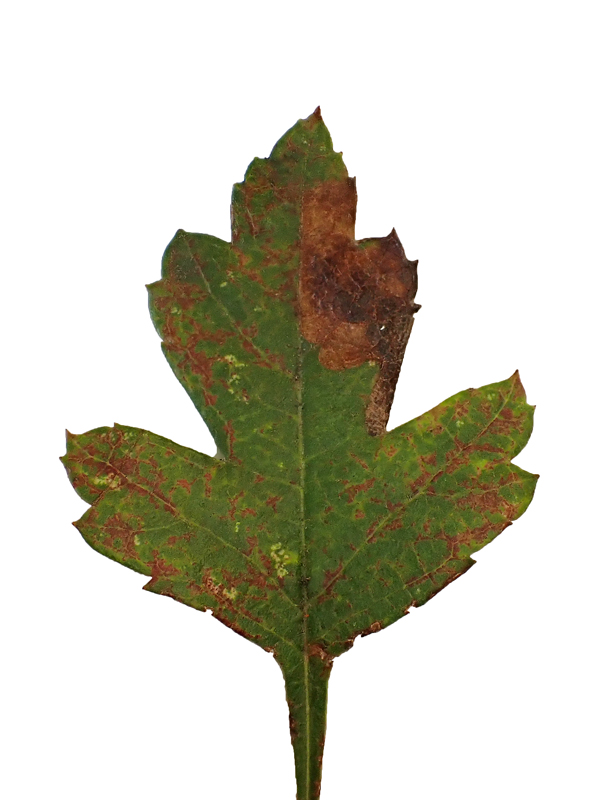
This is a Phyllonorycter oxyacanthae mine on Hawthorn:
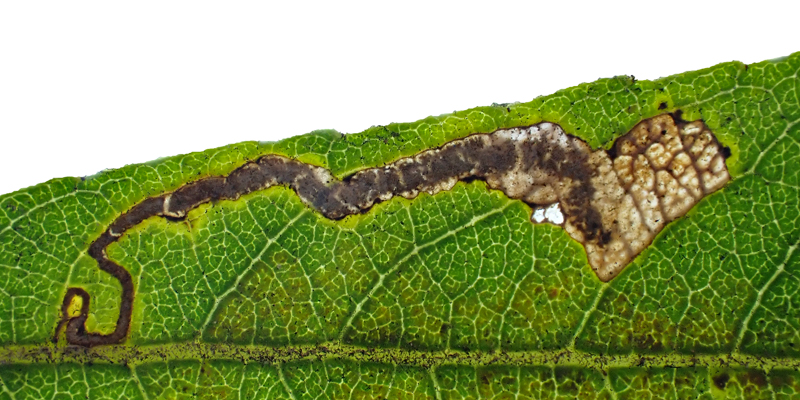
Amongst other species I found on Hawthorn was Ectoedemia atricollis,
like this example:
I initially thought this might be Stigmella paradoxa, but the egg position was
not right and as can be seen there is evidence of a gallery leading into the
blotch.
I found a few mines on Rowan. These folded leaflets, along with the smaller
pinched in mine on a leaflet above, are the work of
Parornix scoticella:
However, along with Lyonetia clerkella that mines everything, the other mines
I found on Rowan were species that I've only previously found on Hawthorn:
Phyllonorycter corylifoliella
Stigmella oxyacanthella
Other mines that I found on what may be thought of as atypical foodplants
included:
Phyllonorycter leucographella on Malus sp.
(alongside Lyonetia clerkella on the plant it should be found).
Here's a couple of other mines for reference:
Stigmella salicis on Salix sp.
Tischeria ekebladella on Quercus sp.
One last mine, this one though from the Silver Birch in my garden:
Phyllonorycter ulmifoliella
That's probably enough mining for now, and I've realised looking through that I needed to crop some of the pictures a bit tighter. Never mind.
I guess this post isn't the mining Public
Service Broadcasting were thinking of.