

Thursday, 29 August 2013


Wednesday, 28 August 2013
Waders
Yesterday we decided to head over to North Norfolk. 'We' means me, Nichola and all three offspring on a family outing, not me and some birding mates off to bash bushes looking for rare warblers and scarce autumn migrants. However it's hard to contemplate going to Norfolk and not lifting the bins at something avian, and so a good compromise site to visit for a couple of hours during the day at least was Titchwell - plenty of birds plus a beach and a nice walk. We'd then move on to a seaside town for some (not necessarily best of) British culture.
Titchwell has a reputation as being very 'dudey'. It is, but I don't care too much about that as I think it's a great reserve with some great birding potential, but I will come back to that bit shortly. I haven't been for c3 yrs so it was good to see the new Parinder Hide, and also new pathways opened up which I'd like to have explored a bit more. The freshwater marsh was alive with waders. Loads of them. One or two were even close enough to point the camera at. Others weren't but I did anyway. Hence here are a load of cropped dodgy shots of waders which there is no point in clicking as they won't go bigger.


Although not apparent from these few shots, most of these species were present as both moulting adults and as juves. Also seen were Ringed P., Curlew, Snipe, Greenshank, Avocet, Lapwing, Green Sand, Common Sand and Turnstone. Best though were a number of Curlew Sands and a Little Stint. And that's when it really hit me about the birding clientele at Titchwell, and some of the visitors there yesterday.
Nobody can be immediate experts on bird ID, and let's face it waders can be difficult sometimes, especially at distance in a big group. However what I can't understand is why people can't look at birds (that are close enough to identify through naked eyes) through their optics and correlate features they are seeing to a field guide and work it out themselves. That's the only way to learn how to recognise key features and subtle differences between species. But no, much easier to sit in the hide and constantly ask 'oh what's this little one down here' 'oh really, how marvellous, I've not seen that one before' etc. I've always been prepared to offer an ID, get someone onto a nice bird etc in hides, but you just feel sometimes that it's worthless with some people who patently have no idea what they are looking at. Even worse, whilst I was trying to grab a few poxy shots with my bridge camera, there were several people with big huge DSLR/lens rigs that were no doubt getting some great shots. Just that they had no idea what they were photographing. One particular couple were happily photographing the above Dunlin, which were part of a larger group with a couple of juv Ringed Plovers, whilst wittering about trying get the Curlew Sandpiper in the same shot (ie hadn't realised there were both moulting adult and juv Dunlin knocking about). Meanwhile in the hide another couple were photographing a Little Stint and Curlew Sand together before asking what they were.


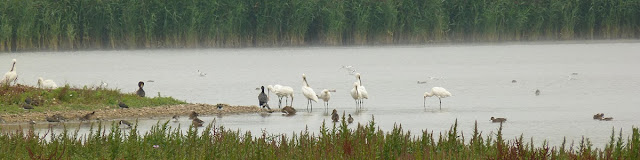
Aside from the waders, not too much else of note apart from a group of ten Spoonbills, nine of which are just about recogniseable in this distant grainy effort (which you can click for a bigger grainier effort).
Titchwell has a reputation as being very 'dudey'. It is, but I don't care too much about that as I think it's a great reserve with some great birding potential, but I will come back to that bit shortly. I haven't been for c3 yrs so it was good to see the new Parinder Hide, and also new pathways opened up which I'd like to have explored a bit more. The freshwater marsh was alive with waders. Loads of them. One or two were even close enough to point the camera at. Others weren't but I did anyway. Hence here are a load of cropped dodgy shots of waders which there is no point in clicking as they won't go bigger.
Spotted Redshank - even moulting birds are spanking
Ruff
Black-tailed Godwit
Dunlin
Although not apparent from these few shots, most of these species were present as both moulting adults and as juves. Also seen were Ringed P., Curlew, Snipe, Greenshank, Avocet, Lapwing, Green Sand, Common Sand and Turnstone. Best though were a number of Curlew Sands and a Little Stint. And that's when it really hit me about the birding clientele at Titchwell, and some of the visitors there yesterday.
Nobody can be immediate experts on bird ID, and let's face it waders can be difficult sometimes, especially at distance in a big group. However what I can't understand is why people can't look at birds (that are close enough to identify through naked eyes) through their optics and correlate features they are seeing to a field guide and work it out themselves. That's the only way to learn how to recognise key features and subtle differences between species. But no, much easier to sit in the hide and constantly ask 'oh what's this little one down here' 'oh really, how marvellous, I've not seen that one before' etc. I've always been prepared to offer an ID, get someone onto a nice bird etc in hides, but you just feel sometimes that it's worthless with some people who patently have no idea what they are looking at. Even worse, whilst I was trying to grab a few poxy shots with my bridge camera, there were several people with big huge DSLR/lens rigs that were no doubt getting some great shots. Just that they had no idea what they were photographing. One particular couple were happily photographing the above Dunlin, which were part of a larger group with a couple of juv Ringed Plovers, whilst wittering about trying get the Curlew Sandpiper in the same shot (ie hadn't realised there were both moulting adult and juv Dunlin knocking about). Meanwhile in the hide another couple were photographing a Little Stint and Curlew Sand together before asking what they were.
Mind you if this was the only view you got it wouldn't be easy.
Aside from the waders, not too much else of note apart from a group of ten Spoonbills, nine of which are just about recogniseable in this distant grainy effort (which you can click for a bigger grainier effort).

Friday, 23 August 2013
Larval Life / Butterfly Bush
Blogging on here has been sporadic at best this year. Oh, you noticed? It's not that I've done nothing or have nothing to say, more that I've been more active on other forums (Facebook since a PSL group was set-up), and Twitter as that was the forum of choice for the Foot-it challenge in January). I've also been posting updates and photos on the 1000k and Garden Moth Challenge blogs. I haven't been uploading anything to my Flickr photostream, though that's just down to time.
I don't want this blog to continue to fester in the background though, and gradually as the 2013 challenges start to wane I'll be posting on here more frequently. Probably not much point trying to catch up anything, though I do now have a lot of stuff for rainy days etc.
So recent topical stuff seems appropriate, and I'll start with some larval life. Over the years I've found and reared a fair number of moth species, some with ease and success and a few with bad outcomes (anything that needs to be overwintered is usually a bad idea in particular). I'm always pleased then when I find a larva that I've not seen before, and often they'll be common species. I found this one earlier in the week ..

It was openly resting on bramble, and the head capsule looked a bit odd so I presume it was dormant pending an instar change. It wasn't familiar at all, so I brought it home to ID and rear through to final instar. I eventually sussed out that it was a Peach Blossom, probably c3rd instar. After a day or so it did change and ID was certain.


Another species I'm seeing a lot at the moment is Grey Dagger, like this final instar that I found on 9th August. This is one that I instantly recognise in later instars.

I found a very small 1st instar larva on my garden Silver Birch at the start of August and bought in to rear. It must be the slowest growing larva I've ever kept, and it is still very small. I wasn't sure what it was initially but I am now increasingly sure it is also destined to be a Grey Dagger.

The final larva is one that I do recognise in all instars, and again I found it as an early instar on my garden birch. It's another ubiquitous species that is commonly found in the larval stage.

The last couple of weeks has brought a big increase in the numbers of butterflies locally, and later broods of Peacock and Small Tortoiseshell in particular seem to be abundan. Also a fair few Commas, and still plenty of Large Whites knocking about.
Garden buddleias are massively attractive to butterflies as everyone knows. We have a huge buddleia in our garden ..... actually, it is not in our garden but just fully overhangs and the trunk is next door. No idea what type of buddleia this is though; the flower spikes are yellow and the florets are in sort of balls. Whatever it is, it is very busy at the moment on warm sunny days with butterflies, bees and hoverflies.


We also have a more standard buddleia in our garden, but it is completely crap. I don't know why but it remains stunted and has no vigor, and yet this plant seems to be able to grow and flourish on the most bleak and infertile wasteland without any problem. The few flowers it does have are still effective though.

Given the upturn in numbers, and the presence of buddleia, I am surprised that both Painted Lady and Red Admiral have not turned up yet ths year. Also no Gatekeeper as yet. The only surprise was this Common Blue on my crappy plant, though sadly too brief to get a good photo in the breeze as it scarpered almost immediately after I grabbed this pants photo.

I don't want this blog to continue to fester in the background though, and gradually as the 2013 challenges start to wane I'll be posting on here more frequently. Probably not much point trying to catch up anything, though I do now have a lot of stuff for rainy days etc.
So recent topical stuff seems appropriate, and I'll start with some larval life. Over the years I've found and reared a fair number of moth species, some with ease and success and a few with bad outcomes (anything that needs to be overwintered is usually a bad idea in particular). I'm always pleased then when I find a larva that I've not seen before, and often they'll be common species. I found this one earlier in the week ..

It was openly resting on bramble, and the head capsule looked a bit odd so I presume it was dormant pending an instar change. It wasn't familiar at all, so I brought it home to ID and rear through to final instar. I eventually sussed out that it was a Peach Blossom, probably c3rd instar. After a day or so it did change and ID was certain.


Peach Blossom
Another species I'm seeing a lot at the moment is Grey Dagger, like this final instar that I found on 9th August. This is one that I instantly recognise in later instars.

Grey Dagger
I found a very small 1st instar larva on my garden Silver Birch at the start of August and bought in to rear. It must be the slowest growing larva I've ever kept, and it is still very small. I wasn't sure what it was initially but I am now increasingly sure it is also destined to be a Grey Dagger.

Almost certainly Grey Dagger
The final larva is one that I do recognise in all instars, and again I found it as an early instar on my garden birch. It's another ubiquitous species that is commonly found in the larval stage.

Vapourer
The last couple of weeks has brought a big increase in the numbers of butterflies locally, and later broods of Peacock and Small Tortoiseshell in particular seem to be abundan. Also a fair few Commas, and still plenty of Large Whites knocking about.
Garden buddleias are massively attractive to butterflies as everyone knows. We have a huge buddleia in our garden ..... actually, it is not in our garden but just fully overhangs and the trunk is next door. No idea what type of buddleia this is though; the flower spikes are yellow and the florets are in sort of balls. Whatever it is, it is very busy at the moment on warm sunny days with butterflies, bees and hoverflies.


We also have a more standard buddleia in our garden, but it is completely crap. I don't know why but it remains stunted and has no vigor, and yet this plant seems to be able to grow and flourish on the most bleak and infertile wasteland without any problem. The few flowers it does have are still effective though.

Given the upturn in numbers, and the presence of buddleia, I am surprised that both Painted Lady and Red Admiral have not turned up yet ths year. Also no Gatekeeper as yet. The only surprise was this Common Blue on my crappy plant, though sadly too brief to get a good photo in the breeze as it scarpered almost immediately after I grabbed this pants photo.
Saturday, 13 July 2013
Tugley Wood
Somehow I've managed to get out and about and see a fair bit over the last couple of weeks, aside from picking up a fair few moths in the garden and seeing plenty of bits out and about in my square.
First up here a few bits from back on 29th June. I joined like minded naturalists down in Surrey at Tugley Wood within Chiddingfold Forest and quite simply we had a brilliant day. Good company, learning lots and I saw a load of new and interesting bits. The plan was to stay over for some overnight mothing and then go to Thursley Common on the Sunday, but news from home that Nichola was being admitted to the Leics. Royal Infirmary brough that to an end and I came straight home (all okay at the moment, problem with seriously high blood pressure under investigation). Some of the highlights on the Saturday included:


First up here a few bits from back on 29th June. I joined like minded naturalists down in Surrey at Tugley Wood within Chiddingfold Forest and quite simply we had a brilliant day. Good company, learning lots and I saw a load of new and interesting bits. The plan was to stay over for some overnight mothing and then go to Thursley Common on the Sunday, but news from home that Nichola was being admitted to the Leics. Royal Infirmary brough that to an end and I came straight home (all okay at the moment, problem with seriously high blood pressure under investigation). Some of the highlights on the Saturday included:
Pachytodes cerambyciformis

Rhagium bifasciatum

Stenurella melanura

Alosterna tabacicolor

Clytra quadripunctata

Evacanthus acuminatus

Poecilobothrus nobilitatus

Metatropis rufescens

Wood White
Strophedra nitidana
I'll cover some recent exciting stuff from VC55 in another post.
Saturday, 22 June 2013
Garden Trap Catches
Struggling to keep up with blogging this year, and not just on here. Posted a big 1000 in 1km square update yesterday which was the first for a couple of weeks, and likewise updated the Garden Moth Challenge.
I haven't posted daily updates from the garden traps, not that they've run everyday. The early part of last week was by far the best so far this year, with lots of NFY moths and quite a few other bits. Since getting the Synergetic trap back in use it has outperformed the 125W MV on every outing except last night - and that's mainly down to the wind gusting through the garden right into the trap path whereas the MV is a little more sheltered. The opposite may be having an effect on calmer nights but the 80W actinic did not routinely out-do the MV, and in particular when the conditions were a little better (eg 7th and 20th May) the MV completely outclassed it. All in all I'd have to say that the Synergetic trap has got to be the trap of choice for the garden - at least for the complimentary trap to the 125W MV (can't see me ever being brave enough to ditch one of those).
Here's a side-by-side comparison of the 125MV versus the 80W actinic and 22W Synergetic on the nights they've been run this year (actinic only running in early season):

17th - 19th June by far the best period so far this year with 41 species added to the garden yearlist, torrential rain in the afternoon and early evening on 20th so no trapping, and very blustery with some rain last night. Hopefully things will pick up again soon.
Garden tick on the 13th, Cydia ulicetana (326th micro, 629th moth).

I haven't posted daily updates from the garden traps, not that they've run everyday. The early part of last week was by far the best so far this year, with lots of NFY moths and quite a few other bits. Since getting the Synergetic trap back in use it has outperformed the 125W MV on every outing except last night - and that's mainly down to the wind gusting through the garden right into the trap path whereas the MV is a little more sheltered. The opposite may be having an effect on calmer nights but the 80W actinic did not routinely out-do the MV, and in particular when the conditions were a little better (eg 7th and 20th May) the MV completely outclassed it. All in all I'd have to say that the Synergetic trap has got to be the trap of choice for the garden - at least for the complimentary trap to the 125W MV (can't see me ever being brave enough to ditch one of those).
Here's a side-by-side comparison of the 125MV versus the 80W actinic and 22W Synergetic on the nights they've been run this year (actinic only running in early season):
17th - 19th June by far the best period so far this year with 41 species added to the garden yearlist, torrential rain in the afternoon and early evening on 20th so no trapping, and very blustery with some rain last night. Hopefully things will pick up again soon.
Garden tick on the 13th, Cydia ulicetana (326th micro, 629th moth).
Monday, 10 June 2013
Alien
The Natural World version 1
a mesmerising, beautiful and truly spectacular place where everything is awesome


Like the rich colours, intricate body markings and rorschach patterning on the head of this Green-brindled Crescent caterpillar that I found on hawthorn on 26/05/2013 and collected to rear.
The Natural World version 2
a despicable, ugly and truly disgusting place where everything is awful


Like the same caterpillar as above after it has been cruelly devoured alive from the inside by these parasitic braconid wasp larvae which have burst out alien-stylie today and pupated around the still-alive hole-riddled host (though not alive for much longer I expect).
In truth of course beauty can only exist if there is horror to measure it against, and either way it's all relative - I expect that the tiny wasps that will emerge will be as stunningly beautiful in their own way as their larval habits are grossly disgusting.
a mesmerising, beautiful and truly spectacular place where everything is awesome
Like the rich colours, intricate body markings and rorschach patterning on the head of this Green-brindled Crescent caterpillar that I found on hawthorn on 26/05/2013 and collected to rear.
The Natural World version 2
a despicable, ugly and truly disgusting place where everything is awful
Like the same caterpillar as above after it has been cruelly devoured alive from the inside by these parasitic braconid wasp larvae which have burst out alien-stylie today and pupated around the still-alive hole-riddled host (though not alive for much longer I expect).
In truth of course beauty can only exist if there is horror to measure it against, and either way it's all relative - I expect that the tiny wasps that will emerge will be as stunningly beautiful in their own way as their larval habits are grossly disgusting.
Subscribe to:
Posts (Atom)