Last week we managed to nip down to Devon for a couple of days and stay with
my in-laws in their new (moved last year) property in Fremington, which is
west of Barnstaple along the Taw Estuary. We couldn't have picked a better
couple of days weather-wise with glorious sunshine and decent warmth. I should
have packed a moth trap but thought better of it, there will be chances in the
future I'm sure. But when I do I think it could be interesting to see what
turns up, as within spitting distance of the garden is a large marshy field
that is part of the Fremington Local Nature Reserve called Lovell's Field
(cyan dot), a small tidal tributary (yellow dot) which becomes Fremington Quay
where it meets the Taw Estuary (green dot).
Around Lovell's Field are a good mix of broadleaved trees, though a lot of the
oaks in the area are
Lucombe Oaks
- a naturally occurring (not in UK) hybrid between Turkey Oak and Cork Oak.
There are loads of them in Devon; I have no idea though if those around here are
self-seeded (unlikely) or planted a couple of hundred years ago (very likely!)
but they do have some sort of preservation order on them I believe.
Although I did not take a trap, I did take a pheromone lure. Within
minutes of arriving we were lounging in the garden in sunshine with a cuppa,
chatting away whilst I had one eye on a red rubber bung. Around half an hour
later I was dashing off to get my net and shortly afterwards showing everyone
this ....
Cracking Emperor Moth
I also hung out a couple of lures in pheromone traps hoping the local oaks
would hold interesting Pammene spp. but no joy on that front.
We had walk around the area, and though there was not too much of birding
interest along the tributary I did find a cracking Greenshank.
Fremington Quay
Whilst walking back along the edge of Lovell's Field, I found masses of
Three-cornered Garlic and some dipteran mines on Hart's-tongue Fern that are
immediately identifiable ....
Chromatomyia scolopendri
We also had a walk around nearby Instow. Nice to get on some sand and enjoy a proper
(Hocking's) ice cream. It's not quite a beach though, the sea is a very long way off: this is where
the main estuary splits into the Taw heading east to Barnstaple and the
Torridge heading south to Bideford. In the far distance in the shot below,
there is Northam Burrows on the left (with Appledore mid-distance) and
Braunton Burrows / Saunton Sands on the right. In between is a massive expanse of tidal sands.
There is a new album from Orbital out later this year, celebrating 30 odd
years with new versions and remixes of classics. Some tracks are already
available, and I like them.
For 22 years, I have recorded and enjoyed moths with Adrian Russell. He was the VC55 County Lepidoptera Recorder when I very first got interested, a role that he effectively took on from c1992 to try and give some structure and organisation to recording in VC55. I first corresponded with him in late 1999 with some moth records from my garden, and from early 2000 we exchanged many phone calls, 1000s (literally) of e-mails and enjoyed many nights out mothing along with the occasional social. We'd not done anywhere near as much out in the field in the last few years due to health issues and covid restrictions, but we did get in a couple of nights last year and a joint leafmining foray in mid-November.
Adrian was very helpful to me in the early days with his time, ID help, access to sites and generally being a model County Recorder. Over the years as my experience and knowledge grew, particularly on micros, Adrian was happy to ask me for help and guidance and over the last few years I've been helping reduce his workload by giving ID help to other recorders and helping with record verification. I've held the emergency back-up files for the VC55 dataset and masses of associated files for the last few years, with the last update coming through as recently as 05/04/2022.
This weekend I'm a bit lost and numb, saddened and shocked by the news that Adrian died on Friday after being in hospital all week. I knew about his illness, knew his prognosis and knew that he was unlikely to see out the year, but no-one could have foreseen such a sudden deterioration in his health.
Adrian had been working for a number of years on a book covering the full history of Lepidopteran recording in VC55 along with the status and details on all moth and butterfly species. It was a project that he'd essentially been researching for and thinking about for years and it is a shame he never got to finish it or see it published in the way he intended.
We shared many nights around a light, many early morning surprises going through traps with camping stove coffee and bacon butties, and added many species and dots to the VC55 dataset in the process. It will be very strange indeed running traps out and about without Adrian around, either sharing the experience or being the first to know of any exciting news.
A typical early morning - which of the x17 traps to empty first ....
Everyone that has run a light trap knows the inherent risk of a wasp or two
(or dozens!) waiting for an errant finger to poke with their stingers. Usually
more of a later summer/autumn risk, and greater in decent woodland with
Hornets around. This morning I was not even slightly aware or ready for a
Common Wasp that was clinging onto the handle out
of view as I went to pick up the trap. Luckily for me, she was just a bit too
cold and dozy and as I grabbed the handle I knocked her off onto the sheet. A
close escape turned into a photo opportunity.
I hope she doesn't come back tonight though!
Not a lot else in the trap, but Brindled Pug, Brindled Beauty, Brimstone Moth
and Shuttle-shaped Dart all new for the year.
I had a few days over in the Netherlands last week for some European football
(albeit in the new third tier UEFA Europa Conference League, though we're in good
company having already put out Rennes and not beating PSV Eindhoven in their home ground, with Roma coming up in the semi-finals).
It's the first time I've travelled overseas since our Caribbean cruise in
2018, thanks to health issues and covid. Of course it was also the first
post-Brexit experience in a European airport as a non-EU traveller .... Glad I
don't have a need to travel for work anymore.
Whilst away the weather turned properly warm and sunny for a few days, though
over the couple of nights that I've had the trap out since getting home you'd
not think it. Poor catches and not much variety as yet.
Oak-tree Pug
Golden-rod Pug
A typically duff looking individual - abdominal plates checked.
Least Black Arches
Dromius meridionalis
The first non-lep in the trap that I've bothered to point the camera at so
far this year
I've got some time off of work next week too, though we'll mainly be
planting up our new raised beds and nipping down to Devon for a quick visit.
Yesterday's post was all about the 'tross, but of course there were plenty of
other seabirds at Bempton with the breeding ledges and cliff faces starting to
build up. The sight, sound and smell of a seabird colony is just one of those evocative birding experiences that make you smile, though many of the other similar
experiences seem to revolve around roosting behaviour, like: wintering geese
flying out from and back in to roost, wader flocks flying back from roosting
to tidal mudflats, and Starling murmurations. Seabird colonies are different
in that there is a constant stream of birds coming and going, a constant hustle and bustle - no wonder they're sometimes referred to as 'seabird cities'.
Whilst numbers are still building, there were already masses of Gannets, Razorbills,
Guillemots, Kittiwakes and a fair few Puffins. Fulmars were constantly
patrolling, and whilst not seabirds there were masses of Rock/Feral Pigeons on
the cliff faces. I didn't take much notice of the other gulls knocking about,
but there were a couple of Shags on the water.
Here's a few clips and shots to round off the day.
Last night I made a snap decision; I was going to get up at the crack of early
morning and drive up to Bempton to hopefully clap eyes on the returning
Black-browed Albatross. This is the same bird (or at least almost certainly
so) that has now popped up for a third consecutive year and likely has been
the same bird observed previously along the east coast (in 2017?). It
shouldn't be anywhere near the UK of course, and should be in the southern
hemisphere. There was thought to be just the one knocking about in the north
seas since 2014, also being seen off of Denmark and Heligoland Germany, but
yesterday both the Bempton bird and the German bird were reported?!
Either way, there is precedent for wayward Black-browed Albatrosses hanging
around over many consecutive years in Northern Hemisphere Gannet colonies; the
one (Albert) at Bass Rock, Hermaness and then Sula Sgeir for c40years from
1967, and one for c34years on the Faroe Islands a century earlier before it
was shot. That one was referred to as súlukongur (The Gannet King in Faroese).
I know I should be getting up stupidly early, driving in the dark and arriving
at places at first light for the best chance of success, but my aged body just
can't do it these days. I left home at 07:30 having cleared a bit of frost off
of the car, and arrived at 10:30 to glorious sunshine, a bit of warmth and
masses of people.
The albatross had recently been knocking about at Staple Newk, a good 20
minutes or so walk south-east from the visitor centre. The view above shows
the headland with an arch visible, and the view below is looking down on that
rocky protrusion from the viewing platform.
Almost predictably, given my tardiness ....
The bird was present early morning, and was seen heading off to sea at c08:45.
I knew that meant I'd have to wait a while, just not how long that while would
be. But I was confident that it had just nipped off to feed and would be back.
I spent a good couple of hours watching, chatting to a couple of blokes and
pointing the camera at other bits. The story was then added to: before leaving
and buggering off seaward, it had been pecked/stabbed by a Gannet and was seen
to be bleeding from it's flank above the leg .... At that point my confidence
ebbed a little.
I headed back to the visitor centre for a quick coffee and a pee. Surely if it
came back, it would be on show when I got back to the platform. It wasn't.
More loitering and chatting; a bloke I'd been talking to pretty much felt
obliged to leave as his wife was loitering with intent. As soon as he'd gone,
an optics-less woman and child stepped into his place to look for Puffins. I
pointed one out, just as a young photographer next to me muttered 'Albatross'.
I looked up, got on it immediately and felt a wave of euphoria. Milliseconds
later, whilst clamouring to get my camera turned on, I turned around a
bellowed 'ALBATROSS' as loud as I could muster - and saw the bloke who'd just
left and many others come hurtling back to the platform.
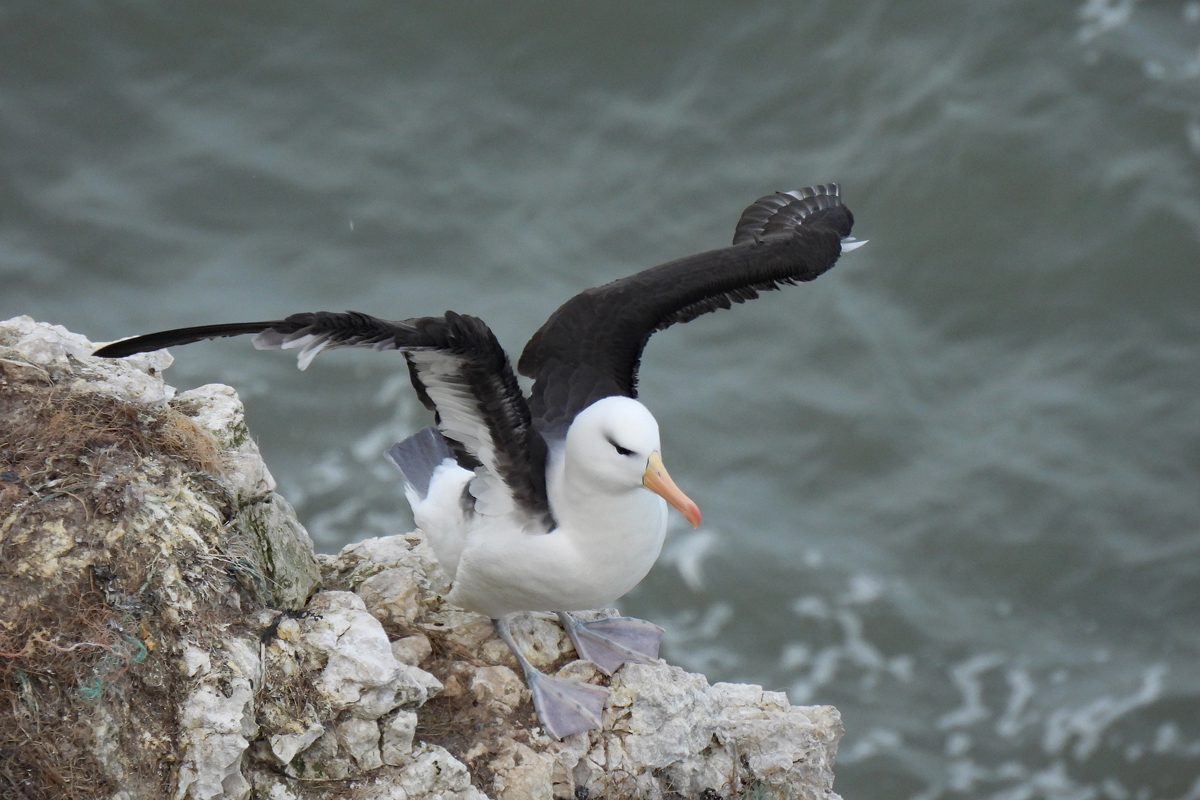
Wow. Absofuckinglutely awesome watching this enigma soar around, repeatedly
trying to land and then going around again for more attempts. It was on view
for a good 10 - 15 minutes, but then seemed to drop in and land out of sight.
I warn you, multiple shots and clips follow. There are certainly much better
shots from proper photographers with much better camera rigs than my
point-and-shoot bridge, but they're not my shots and on that basis are
irrelevant to my blog.
I tweeted a quick update, including that the bird was now out of view from the
platform, and almost immediately it was out again. Same routine, majestic flight
and dithering about landing, before again dropping out of view from the
platform.
At that point I headed back towards the centre, stopping at the next platform
looking back towards Staple Newk to see if it could be seen. As I did so, it
started flying around again but this time appeared to land in a position that
would be in view .... so I walked back.
I now felt like I had properly enjoyed the bird; superb close flight views
and good views of it perched - although it still didn't quite looked settled
and seemed properly agitated about the Gannets. I walked off towards the
visitor center for the final time. A quick stop to look back towards Staple
Newk again, and the albatross was still in view on the same ledge - briefly
- and it was back in the air. I expected the same routine, but it seemed to
be coming closer. And closer. I dropped my bins down and realised it really
was coming close - literally over our heads and heading north. I tracked it
along the coast until out of view over a headland heading towards Filey at
c15:45.