Birds, Leps, Observations & Generalities - the images and ramblings of Mark Skevington. Sometimes.
Showing posts with label Martinshaw Wood. Show all posts

Wednesday, 5 February 2020

Fruit Flies

Got around to pinning and grabbing a shot of the wing patterning on the x2 Tephritis sp. that I beat out of a fallen pine in Martinshaw Wood at the weekend. One I recognised but wanted to double-check, one I wasn't sure of at all and it turns out to be new for me. Photos are not great, I think I might see if there is a newer USB microscope out there with a better resolution.

Tephritis formosa

Tephritis neesii - a new one for me

Sunday, 2 February 2020

Conifer Bashing

I recently acquired another book for the shelf:


I was mainly intent on getting literature on the much smaller 'inconspicuous' ladybirds, but flicking through reminded me of a few of the larger 'conspicuous' species that I've not seen for many years. One in particular stood out, Striped Ladybird. I saw this way back on 15/08/2001, and at the time it was an interesting but not especially relevant bit of moth trapping by-catch. I'd not long started photographing moths, and it must have seemed at least nice enough to point the lens at ....


As it happens, it was just as well that I did bother as it turns out it was only the sixth record for VC55, and there has not been one since. It was attracted to a trap during a session at Martinshaw Wood, along with Eyed Ladybird - another I've not seen for a long while. The new book highlighted that both are coniferous specialists, along with a few other species, which makes sense why I've not seen them recently as this is not a habitat that I spend much time in and certainly haven't moth-trapped for a while.

I had a couple of hours spare on Saturday morning before heading off to the early LCFC kick off, and so I decided that I'd head over to Martinshaw Wood and bash some conifers in the hope of picking up a ladybird or two.


Martinshaw is a decent sized wood, bisected by the M1. It has large sections of conifer plantation but there is also a good area of mixed woodland. It would be good to get in there again for some proper mothing sometime. However as to the aim of the morning, I immediately realised that it was not really a good plan as the decent coniferous branches (ie pines) were well out of reach and the branches that were in reach were not the right type (eg cedar / cypress).

Still, I had a good bash and got some decent exercise. Whilst I drew a blank on the intended targets, I did manage to fill a few pots with a variety of stuff showing how valuable conifers can be as overwintering sites for all manner of inverts. I've got a few small spiders still to sort, and a couple of Tephritis sp. and a barkfly to try and photograph, but this fallen pine yielded the best surprise:


Box Bug

Box Bug first appeared in VC55 in 2014, and it's one I've been expecting to bump into before long as it spreads but finding one by bashing a fallen pine in winter was not what I had in mind. Amongst the spiders that I could identify was this nice one:

 Diaea dorsata

All in all a very nice couple of hours. I also got to see some bits of woodland there that I've not seen before, as I completely lost my bearings and headed energetically in the opposite direction of the car park ...

Wednesday, 3 April 2019

Bramble Nep

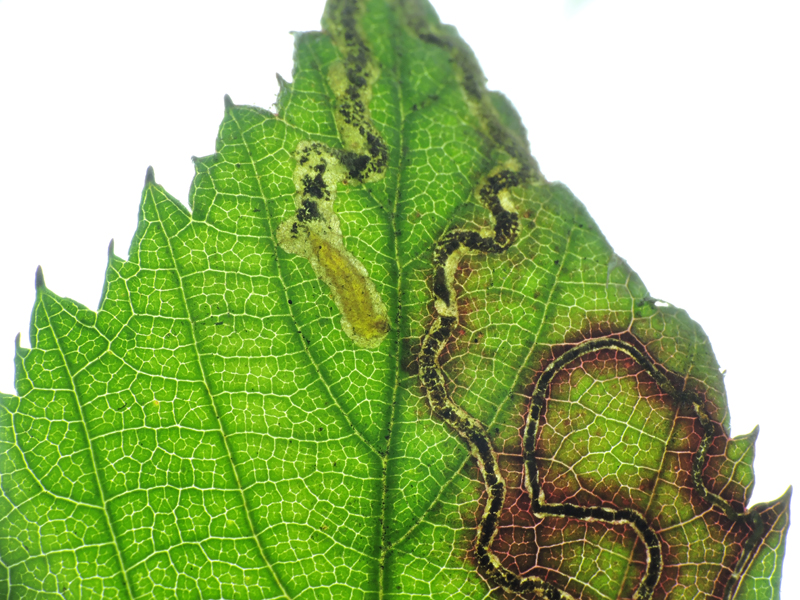
A few weeks ago on 11/03/2019 I found both vacated and tenanted mines on bramble at Martinshaw Wood that were right for Stigmella aurella ....

Vacated mine, very 'silvery' looking with reddening around the edge and (though you can't see it here) dispersed frass within the mine.

Tenanted mine

Tenanted mine

Tenanted mine showing larva and dispersed frass

I've only tried rearing nepticulid leaf-miners once before without success, but I decided to have another go. Both tenanted mines that I collected completed successfully to the larva leaving the mine and pupating in a tiny case, and both have emerged - one yesterday and one today.

Getting anything like a decent shot of these tiny beasts is nigh on impossible with my gear, although as per I've not helped myself by trying to zoom in too far. Anyway, here's one of the adults showing the punky orange head you'd fully expect for this species (Stigmella splendidissimella which also mines bramble, though the mine is discernibly different, has a black head).

Saturday, 7 October 2017

A Man Eater

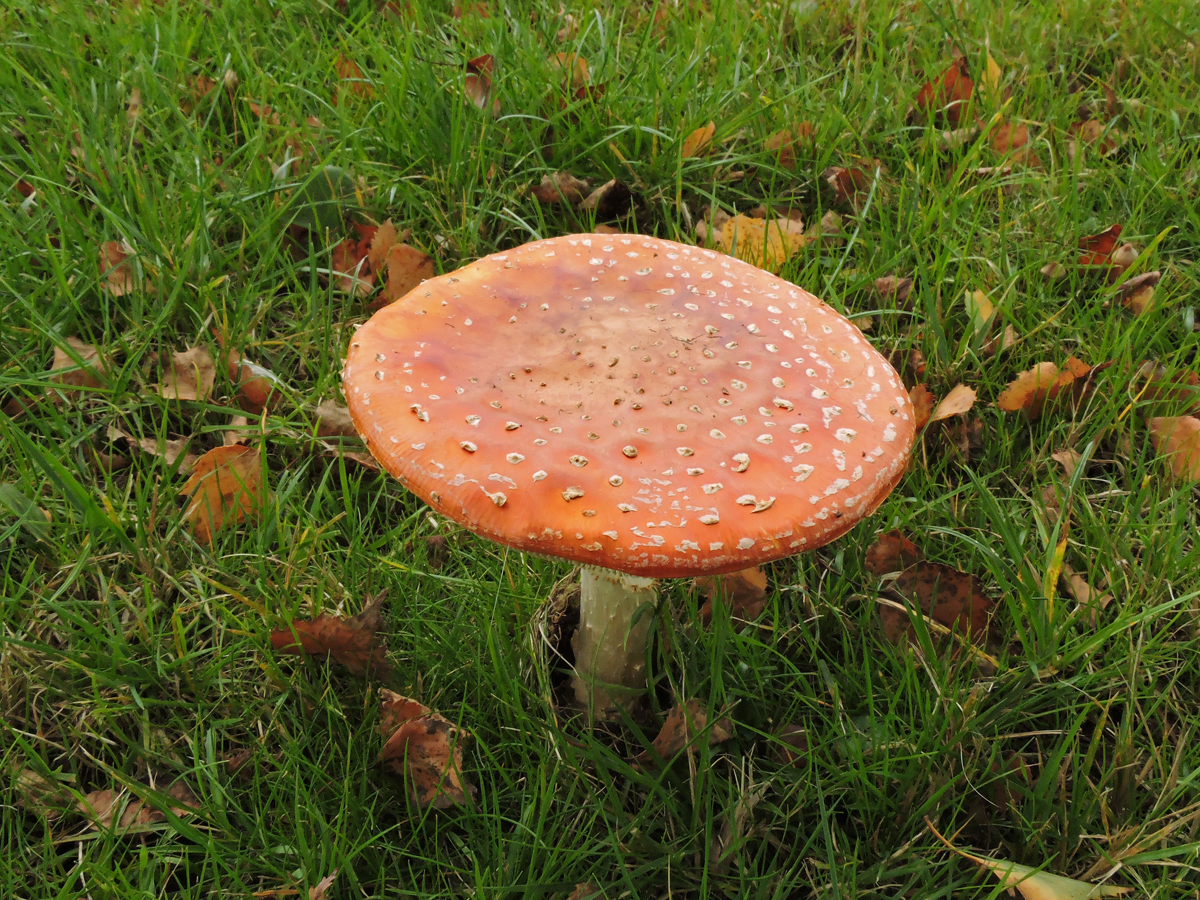
Fly Agaric (Amanita muscaria)

Had another go today at looking for Fly Agaric. We've got our nephews up with us this weekend, so I only had a short slot in the early afternoon whilst the kids were all at the cinema. I headed over to Martinshaw Wood this time, but after strolling around the paths and going off-piste there was no sign of anything resembling red balls on white sticks. I did find a few bits, including these two:

Presumed Orange Peel Fungus (Aleuria aurantia)

No idea - on birch

I decided to leave Martinshaw Wood and head up towards the Charnwood area again, maybe having a quick look at Beacon Hill or somewhere similar. I took the obvious route from Groby along the road to Newtown Linford. Bugger me, as I turned the last corner before reaching the Newtown Linford junction - there bold as brass on a roadside mound were several bright red fungi. I managed to park up alongside the verge and fill me boots, and it was a lot easier than trudging around dark woodland! There were young and old specimens pretty much going through the full spectrum of maturity from spherical to flattened to upturned. I grabbed shots of a few, except the very old virtually unrecogniseable ones.


This one was on the same mound, and there were others that may have been the same but completely gone over.

Brown Birch Bolete (Leccinum scabrum)

And growing on one of the birches on the mound was this.

Hoof Fungus (Fomes fomentarius)

Monday, 24 July 2017

Nice Pear

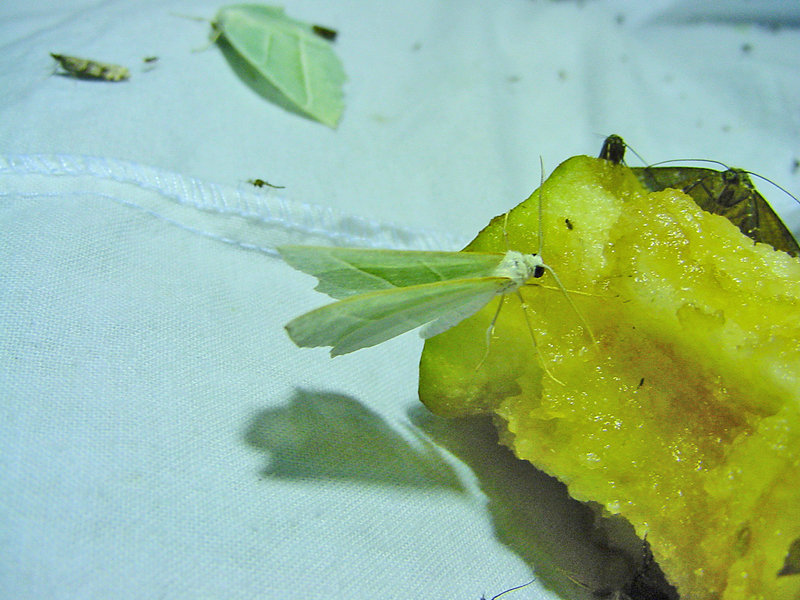
All this recent banana-ing lark in the garden reminded me of an unplanned but novel event some years ago, and I set about trying to find a couple of photos I knew I had somewhere on an old external hard-drive. Anyway, it was way back in 30th June 2001 and a group of us were running a light over a sheet in Martinshaw Wood in Leics. This is back when running a tripod and sheet for a few hours was about as hard-core as it got for us, before the days of running a stupid number of traps over night.

One of the group (I'm sure not me) had brought along a couple of pears, of all things, for a snack. After polishing off the first one the core was accidentally dropped and ended up on the sheet. Being blokes, no one bothered to pick it up and chuck it into the undergrowth .... which turned out to be a good thing.

Quite soon after the fruity core hit the sheet, one or two moths gravitated towards it. Before long we were watching out for moths on the pear rather than round the light. I'm sure none of the moths were primarily attracted by the pear, but it certainly got their interest once they were on the sheet. The other pear was duly half-eaten and dropped to add to the spectacle.

Here's some crappy old digital photos under MV light at night photoshopped back to some semblance of life showing Mottled Beauty, Tawny-barred Angle, Light Emerald, Large Fuit-tree Tortrix, Barred Fruit-tree Tortrix, Green Oak Tortrix, Ingrailed Clay and Plain Golden Y on it. There were probably others, but you can't expect me to remember everything that happened 16 years ago unless there's a photo .........


Saturday, 12 February 2011

Moths, Martinshaw, Spring

It was just dusky as I arrived home from work yesterday, and the first thing I noted was a micro flying about the front door light. It was the first Agonopterix heracliana for the year, with another already settled on the patio door at the back of the house. I got the 80W actinic setup up and switched on. A little while later, we went to drop Josh off at a local woodland for some weekend camping with the Cubs. By then it was a bit drizzly, but I did note a few moths flying about the dark country lanes. Whilst handing said child over, I spotted a familiar shape resting on the outside of a window in the scout hut - a March Moth, though sadly out of reach to pot up for a photo. By the time we got home the drizzle had turned to light rain and then subsided - I checked the trap and found no moths, so I drained the pooled up water away and left it on. Before I went to bed, another check revealed a Pale Brindled Beauty and an Early Moth. They were still present this morning, but the only other moth was by far the earliest garden Hebrew Character I've recorded (previous earliest 9th March 2007). Brings the garden yearlist up to a modest 7 species, and the overall yearlist up to 12.


This morning I headed over to Martinshaw Wood for another TTV. Topping the list in terms of birding interest were a Marsh Tit, 3 Nuthatches and a couple of Siskins and Jays. The whole wood was dripping with tits. As ever these days, I found myself losing birding concentration and looking at other things .....

Hazel catkins very obvious throughout the wood

Some sort of fungi on birch in a damp shady part of the wood - any ideas?
(actually this is a slime mould, possibly Reticularia lycoperdon - thanks Nigel)

Both the above on the same dead birch - Birch Polypore

There's something appealing about a knarled birch bark with lichen

Martinshaw Wood - a typical view

Back at home, further signs of spring were evident (you have to realise I haven't seen any daylight at home since last weekend!). There are bulbs poking through everywhere, the cultivated primroses are flowering, crocuses are up but not quite open, but these are out and proud ..


Quite a few 7-Spot Ladybirds around today aswell.

Saturday, 13 November 2010

Fungal Infection

Another TTV this morning - and again nothing unexpected or extraordinary. Martinshaw Wood is good for mothing, but relatively dull for birds. It is bisected by the M1 motorway, surrounded by housing and as I discovered this morning it is frequented by hoards of early morning dog walkers and ATB cyclists.


All this disturbance probably doesn't make too much difference to wintering birds, but the woodland is predominantly coniferous with little fruit bearing scrub. Anyway, a few very noisy Jays, and small groups of busy Goldcrests and Coal Tits were the most interesting species, along with single Great Spotted and Green Woodpeckers and a stealth Sparrowhawk.

I found a load of fungi that as ever I can't identify. This interest in finding fungi is getting infectious - but as someone that can barely identify all but the commonest trees, plants and flowers I am coming to realise that I am bloody useless at working out fungi ID. I think that these are all the same species at different stages of growth, and I have confidently narrowed them down to being fungi that grow out of the ground rather than on tree trunks. Any help beyond that would be appreciated!

(post-script - I now think these are various states/ages of Clouded Funnel Clitocybe nebularis)


The last two images are the same two fungi shown from both sides. These were big, 5" - 6" across.


Whilst having a cuppa before I set off, I had an opportunity to balance my life karma - whatever that means. A Dunnock flew straight into our living room window. Not the first bird to hit it, and probably not the last, but this one hit it with a real hard smack. I went out to find said Dunnock flat out on the path below the window - eyes open and panting heavily. I anticipated that it would croak any minute, but I carefully picked it up and was pleased to see that its head didn't flop pathetically to one side and that its wings appeared intact. [Holding small birds in the hand always seems to be a privilage - hard to believe that anything so small and fragile can be so tough and hardy.] It was still very likely that it would have suffered some damage, but apart from obvious shock nothing I could see so I carefully put it into a safe place away from any prowling cats etc. It was still there before I left the house, and appeared to be more settled with more relaxed breathing. I guessed it would either survive and go or fall over and cease to exist. Gladly it was not there when I got home, and I'd like to think that it has managed to fly off to fight another day (and I refuse to consider any other possiblility).

Before I go and do something more useful, here is a Winter Moth that came to a lit window early last night. This is usually the last species I see each year - hopefully not this year though.

Winter Moth