Birds, Leps, Observations & Generalities - the images and ramblings of Mark Skevington. Sometimes.
Showing posts with label Dahlica sp.. Show all posts

Sunday, 11 April 2021

Rushing

Yesterday I followed up on a tip-off from Graham Finch and headed out to look for some larval life that would provide a lepidopteran tick. What I didn't realise until checking afterwards was that I was getting a vascular plant tick in the process. I headed out to Kinchley Lane that runs along the side of Swithland Reservoir, the site that I usually go and look for Psychidae early in the year.


See all that green stuff on the bank around the birch trees and at the base of the wall, well it's not just grass - it's Great Wood-rush. Clearly I have seen this many times whilst on that lane, but I've never taken any notice of it and it wasn't on my list. Here's some shots of the general appearance, hairy-edged wide leaves (for a wood-rush) and flower spike ....


Anyway, what I was looking for on this plant was leaf mines like this one ....


A creased blister causing the leaf to fold in on itself on older mines. I found a few, and collected what I thought was two tenanted mines and one old vacated mine ....
It was then that I noticed that what I thought was an older mine was going in the opposite direction to the others: this one had a frass collection nearer to the tip of the leaf with the mine heading basally. And, despite appearances all three mines were tenanted.


I needed to open the mines to check the larva to be sure on the ID. This larva was clearly not impressed as it constantly shuffled up and down the leaf so I had to whack up the ISO to get a clear enough shot.


So, mines on Great Wood-rush tenanted by a greenish larva with a brown head and prothoracic plate which is darker at the outer margins (as opposed to whitish-grey with black prothoracic plate) confirm this is Elachista regificella (and not Elachista gleichenella which may also mine this plant). Sweet. Highly unlikely that I'll get one reared through but it has to be worth sweeping the plants in late June - mid July. Great Wood-rush seems to be localised in VC55, mainly around the Charnwood area including Swithland Wood.

Whilst I was there I had a quick look for Psychidae. Every year there seem to be fewer cases, or perhaps my eyesight is getting crapper.


A couple of Dahlica sp. above (probably D. lichenella based on size and lack of obvious insect fragments), Narycia duplicella below.


I also found a few Dyseriocrania subpurpurella loafing about including this pair in-cop.


And there were loads of Alder Flies, none of which I bothered collecting to check exactly which one.


It was pretty nippy whilst I was out and certainly not inspiring enough to spend a lot of time looking around. I headed to Ulverscroft to have another look at the Infucitinea argentimaculella colony, and found absolutely loads of tubes. None that I collected last year were successful, so I think his year I'll go and collect a few in late June by which time they'll have pupated.


Sunday, 20 May 2012

Swithland Gold

Yesterday morning, a Golden Oriole was heard singing from Buddon Wood next to Swithland Reservoir and seen briefly by the (presumably well chuffed) finder. The news came out a bit later in the day and, predictably, there was no further sign or sound in the afternoon. I had given up any hope of this one sticking and bucking the trend for the most of the previous VC55 records. I was therefore surprised to get a text early this morning that it was singing again, and quickly got myself sorted and doen Kinchley Lane to join the throng of usual suspects. Within a couple of minutes, I was listening to the evocative fluty song coming from the canopy - superb. It's literally years (c15) since I last saw or heard Golden Oriole, but it's one of the most memorable bird songs you'll ever hear on these shores. Over the next hour or so it sang intermittantly and also gave plenty of calls. Whilst the song is beautifully melodic, the call is a raucous screech - I imagine a squirrel having it nuts squeezed would sound similar. No-one actually saw this bird today - but like me, everyone will be adding to their county lists. Splendid. Masses of Swifts were over the water early on, but as the morning wore on and the Oriole became a bit more quiet I switched my attention away from birds and started looking at the walls and for opportunities to play with the new macro lens converter.

I found lots, but rather than post them all here in one go I'll drip-feed them over the next few posts. And for a change I'll start with moths!

Carpatolechia proximella

Common Footman

Dahlica triquetrella - these will probably be full of eggs / tiny larvae by now

Taleporia tubulosa

Psyche casta - loads of these around

This will now be known as Oriole Clearing

Adela reaumurella - loads along the lane

Monday, 16 January 2012

Bagworms & Bagworth

Yesterday morning was very cold again with a crisp frost, but the skies were slightly clouded over and the light was a bit crappy until later in the day. I headed over to Swithland Res for a quick scout around, mainly so that I could get the 2012 moth yearlist off of zero.

There can't be too many sights and sounds more evocative than whistling Wigeon and Teal on a still early morning reservoir with a chuffing steam train running in the background - click for big and imagine it ...


Other than the usual wildfowl, there was nothing too exciting bird-wise though a Peregrine in the usual tree and a Grey Wagtail along the usual stretch of the dam made it on to the yearlist.

A good search along the Kinchley Lane, dam and causeway walls produced six moths - all in the larval stage safely tucked up inside their cases. Aside from a handful of Coleophora serratella, they were all member of the Psychidae (or bagworms as they are sometimes called).

Taleporia tubulosa

Dahlica triquetrella - slightly bigger and 'grainier' than lichenella

Dahlica lichenella - slightly smaller and more 'licheny' than triquetrella

Psyche casta

Luffia ferchaultella (or lapidella f. ferchaultella depending on which Taxonomist you talk to)

The Dahlica spp. are not generally separable on the cases alone, however I've seen so many of them and reared a few through successfully over the years so I think I have my eye in for them. Sadly I couldn't find a Narycia duplicella otherwise it would have been an (almost) clean sweep on the VC55 Psychidae.

Next I decided to nip over to Bagworth Heath for a very quick look around. I had Siskin and Redpoll in mind but in fact it was very quiet. A crusty lichen on the fisherman's platform triggered a memory of a recent photo on the Leicestershire NatureSpot, which when I later checked was undoubtedly exactly the same patch.

Lecanora muralis

A bit further round the site I found a couple of long-dead logs in damp shade covered in moss and lichen, which on closer inspection were one of the 'pixie-cup' types which I think is Cladonia chlorophaea.

Should be called Shrek's Ear Lichen


Also on the same logs was this fungi, which I think is Hairy Curtain Crust (Stereum hirsutum).


Heading out for a whistle stop business trip tomorrow, though not sure how the travel was planned! It's two flights (Birmingham - Amsterdam - Budapest) followed by a 2-3hr taxi ride to Kosice tomorrow, all day meeting in our plant on Wednesday before heading back to Budapest, and then the return flights very early on Thursday morning. I doubt there will by any time to actually see and enjoy any of the places ........

Wednesday, 19 January 2011

The annual Psychidae fix

Nipped over to Swithland Res at lunch time. Scoping from the dam I eventually picked up the White-fronted Goose that's latched onto the Greylags - it was about as far away as it could possibly be on the southern side viewing from the causeway. Aside from a few Shovelers (which were nice) and the usual ducky suspects, nothing exciting.

I therefore resorted to looking at the wall and finding the ever-present Psychidae. Actually, although it was cold the sun shone brightly and the small larvae-filled cases on the causeway wall were actively moving about - usually they are motionless when I look. Used this as an opportinuty to challenge the macro on the Lumix - it is nowhere near as good as my usual Nikon CoolPix 4500 for this sort of stuff, but I want to maximise the one camera in the field approach so I can keep posting all manner of rubbish on here.

Luffia ferchaultella (or Luffia lappidella f. ferchaultella, depending on which taxonomist you talk to). More practice required with the macro function but better than nothing by a long way.

In fact, I also tried a bit of macro-video. Maybe not so successfully, but you get the gist ...


I then nipped over to the dam side, but with the bright sun and distant birds I really couldn't be arsed to look for Smew. Again resorted to the Psychidae. L. ferchaultella present in much smaller numbers (though not sure I remember seeing it on this side), but more pertinently were the various Dahlica spp. cases - both triquetrella and lichenella present.


Not enough time to look for Psyche casta, Taleporia tubulosa and Narycia duplicella - another day, probably when Orange Underwings are flying unless something birdwise turns up. With the garden five, the Martinshaw Chestnuts and Swithland Psychidae, the moth yearlist is up to 9 species .....

Sunday, 11 April 2010

From the garden trap

Not such a nice day weather-wise, a little cool and breezy with few sunny spells. Just aswell really as I spent most of the morning working on a Diploma project and this afternoon trawling around car dealerships looking for something to replace our knackered and expensive-to-run Galaxy.

I did get my microscope out and checked out the Dahlica females from yesterday, plus another that emerged today. There are four things that can be checked: the pupal exuviae headplate, the number of tarsal segments on the legs, the number of antennal segments, and the structure of the anal spines. Checking them is one thing, getting an image with my microscope is extremely hit and miss and I decided not to bother. You'll have to take my word for it that I had 3 x Dahlica triquetrella (including the female pictured yesterday) and 1 x Dahlica lichenella. Here's a couple of older shots showing what the headplates look like:

triquetrella left, lichenella right

The garden trap was similar in numbers to the previous night, though nothing new for the year. Total catch was 48 of 10sp. (125W MV 24 of 8, 80W actinic 24 of 7).

0663 Diurnea fagella 1
0688 Agonopterix heracliana 1
1524 Emmelina monodactyla 1
1746 Shoulder Stripe (Anticlea badiata) 1
1917 Early Thorn (Selenia dentaria) 6
2182 Small Quaker (Orthosia cruda) 1
2187 Common Quaker (Orthosia cerasi) 9
2188 Clouded Drab (Orthosia incerta) 7
2190 Hebrew Character (Orthosia gothica) 19
2243 Early Grey (Xylocampa areola) 2

Saturday, 10 April 2010

Snakes n stuff

Another superbly warm sunny day. After emptying the moth traps and giving Nichola a lift into work, I headed out to Ketton Quarry with the boys to have our first go this year at searching for reptiles.

By the time we got there it was already very warm, and there were no snakes basking in any obvious spots. Someone was already there looking, and had been for a while, but he'd seen only 1 female Adder which was now still just about viewable but only as a tail-tip. There was a small male Grass Snake out in full view allowing very close views - however it was dead! We moved down to the other main area and soon found a very lively and active Grass Snake. We got good but brief views which kept the boys happy, but no chance of photography. We also found a handful of Common Lizards but again they were very lively and would not sit still for a few seconds. We'll try again in a week or so - either we were too early in the season or the very cold winter has demolished the reptile population in the area.

Also on site I picked up good numbers of active butterflies, including Peacocks, Small Tortoiseshells, Brimstones and a Comma. Also plenty of bees of one sort or another, and a fair few of these bizarre Bee-flies (which I think are Bombylius major):

Bee-fly

Whilst there, at least two Blackcaps were in full song plus a couple of Chiffchaffs. Before leaving, I collected a few Teasel seed heads to check for and rear the tortrix Endothenia gentianaeana. I later checked one and found a larva so I expect all of the collected heads will be populated.

Endothenia gentianaeana

On the way home, I had a very quick look over Eyebrook Reservoir. Nothing too exciting - no terns or waders - though this flew over the road just as I was moving on. I managed to jump out of the car and point the camera for a crap record shot.

Osprey

Shame is that with the plethora of translocated birds and their offspring, I just can't get excited by Ospreys in our county.

Back home mid-afternoon, just in time to post a bet on my Blue Square account for the Grand National and make a modest £25 profit after backing the winner.

Later on, I checked the Psychidae from Monday that I brought back to rear/check and I found that 3 of the Dahlica spp. had emerged and the apterous (no wings) parthenogenetic (no males) females were actively egg-laying into the vacated cases. I will hold on to the cases for a couple of weeks before taking them back to the wall they came from. I need to get the spent females and the head-plate from the pupal exuviae under the microscope to confirm exactly which species they are (hopefully I've got both).


A short clip of the unfertilised female pumping the vacated case full of fertile eggs .....

Meanwhile, from the garden trap last night, 32 of 10sp. (125W MV 14 of 7, 80W actinic 18 of 5):

0667 Semioscopis steinkellneriana 1
0688 Agonopterix heracliana 1
0697 Agonopterix arenella 1 [first for year]
1524 Emmelina monodactyla 3
1746 Shoulder Stripe (Anticlea badiata) 1
2182 Small Quaker (Orthosia cruda) 1
2187 Common Quaker (Orthosia cerasi) 1
2188 Clouded Drab (Orthosia incerta) 3
2190 Hebrew Character (Orthosia gothica) 19
2243 Early Grey (Xylocampa areola) 1

Agonopterix arenella

Monday, 5 April 2010

Pseudo & Psychidae

I had really fancied a bit of blatant twitching over this weekend, but seeing as the Lesser Ketrel inconsiderately fecked off before Friday I couldn't be arsed with travelling to Suffolk/Essex/Kent just to see Pallid or Alpine Swift - I've not seen either in Britain due to considerable lack of effort and having never twitched either, but have seen both abroad.

With nothing else worthy of travelling for, I inevitably spent the day out pseudo birding in Leicestershire with family in tow. I suggested we have a good walk all around Beacon Hill as it would be much less busy than similar sites.

Turned out to be a good choice - a peaceful walk in fresh air without having to tolerate hoards of ignorant tossers. Sadly, the birds were also pretty thin on the ground. There were plenty of Chiffchaffs singing, but no Willow Warblers and no Wheatears anywhere. Nice to see and hear common species getting busy though, including Jay, Nuthatch and Great Spots.


In a scene reminiscent of the appalling Bill Bailey bird-spotting based pile-o-shit, the kids decided to build a 'hide'.

Alex adds the finishing touches

Whilst they did that, I busied myself with this:


Lichen/moss covered dry stone walls are superb places to check for psychidae - surely the most bizarre group of moths bar none. Within seconds I'd found several Narycia duplicella cases, all c6mm long and apparently inhabited.


I've reared this species before, and the fully winged adults are quite smart so I collected a few to have another go. I also found a small Common Footman larva, only c15mm long - probably only just starting to feed up after overwintering.


We spent a good few hours at Beacon Hill, and spurred by the stone wall success I insisted we go home via Swithland Reservoir.

Along the causeway, as usual, there were 100s of inhabited larval cases of the parthenogenetic apterous form of Luffia lapidella (f. ferchaultella) - what a mouthful. The larvae live in their cases for c9 months before pupating within the case, emerging as a wingless female which promptly lays viable eggs within the case and dies. The tiny larvae set about making their own cases after hatching and the cycle starts again. No males involved. I can't see it catching on.
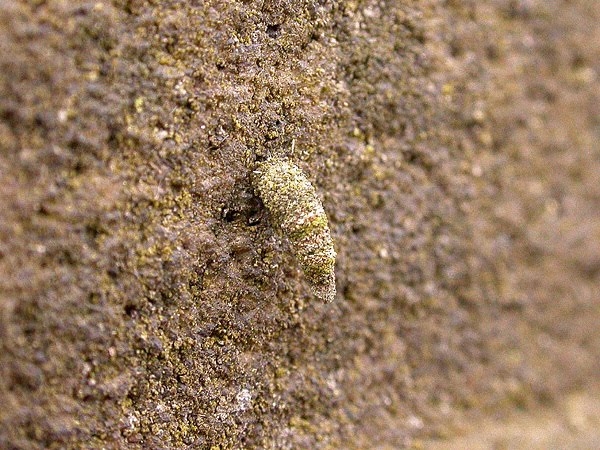

From Kinchley Lane, I picked up plenty of Swallows and Sand Martins low over the res (c40 of each). No sign of either Taleporia tubulosa or Psyche casta cases, so I carried on to the dam and set about potting up a few Dahlica spp. cases to try and rear through. We have both D. lichenella and D. triquetrella in the same section of wall. Again these are both apterous and parthenogenetic. They can only be reliably separated by microscopically assessing the number of tarsal segments or the pupal head-plate - hence potting a few to check.


Some of the mosses on the dam wall were 'flowering' - probably.


Tomorrow looks to be the best day weather-wise for a while - fecking typical as I'll be back at work!