Birds, Leps, Observations & Generalities - the images and ramblings of Mark Skevington. Sometimes.
Showing posts with label Phylan gibbus. Show all posts

Saturday, 29 February 2020

Waterworks

Today I've been to work, which didn't matter much as this morning was dull and drizzly anyway so I wasn't planning on going anywhere. By the time I'd left it was drier, albeit with a strong biting wind making it feel bloody cold despite the sun poking through.

I mentioned a few days ago that Jubilee Park and the floodplain area over the road was almost constantly flooded, and that there was some work being done. During that time the area did drain enough to see that they had made some progress with a wide channel .. but this morning it was all under water again. So on the way home, I pulled over to grab a couple of shots on my phone although by then the sun was completely in the wrong place but you get the gist.


Somewhere to the right of the temporary fenceline that you can see is the River Soar, and on the left of that fence is a deep wide channel which is (so far) completely ineffective!


The machinery is sitting in water in a makeshift compound, though they have moved out the portacabin that has flooded several times whilst in situ.


I still have several gigabytes of photos to sort and archive, a job that I started last year and have made good progress, but it will take a fair while. And I'm still finding a few bits to put up here from periods when I wasn't making time to post anything.

Such as these, yet more retro beetles, these all from the last PSL meet-up I went to over at Holkham in June 2016.

Broscus cephalotes

Phylan gibbus
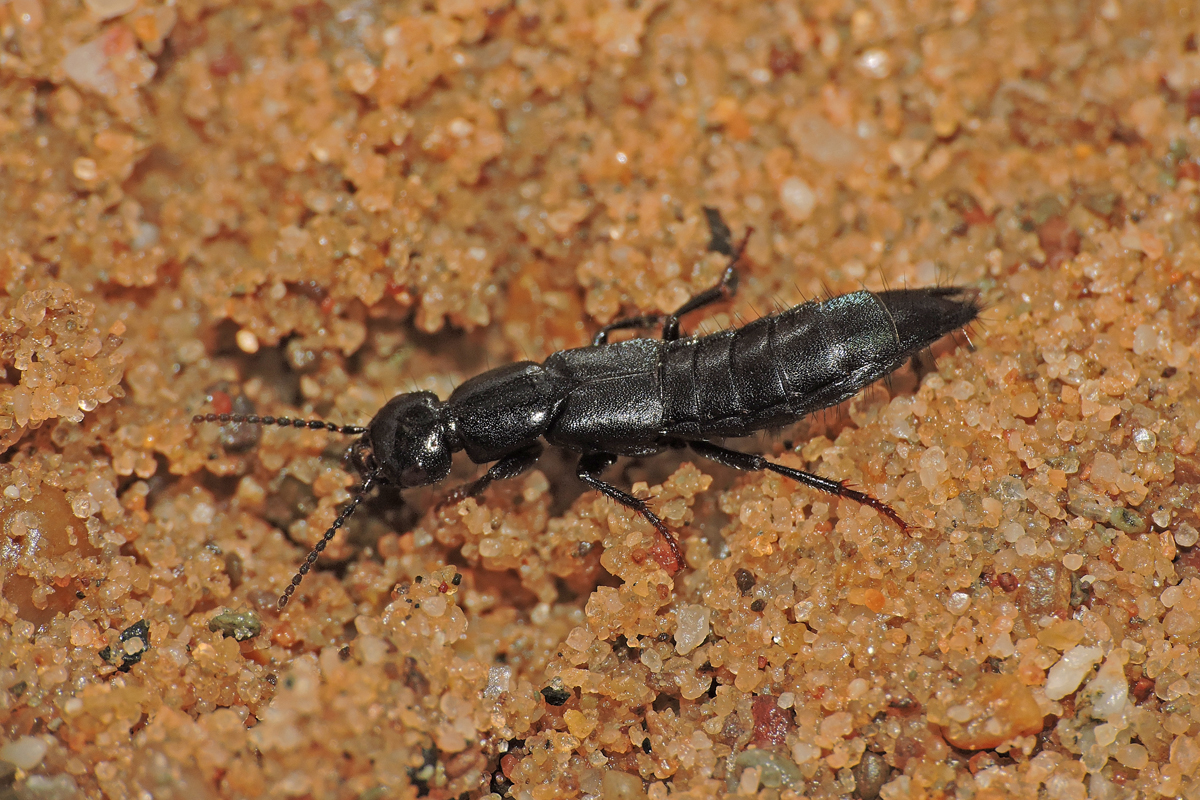
Tasgius ater

Agrypnus murinus

Calathus mollis


Sunday, 12 April 2015

Northam Burrows, North Devon

We've had a cracking week down in Devon with some superb sunshine and warm weather. Amongst our days out enjoying the weather, on Thursday we headed out for a walk around Northam Burrows Country Park. This site is a mainly dry grazed grassland (there are a couple of more marshy bits) and coastal dune system around a links golf course on the north-west coast, right at the mouth of the Taw/Torridge estuary. And very good it turned out to be for my beetle list too! Whilst I had gone prepared to pot up a few bits if anything caught my eye, I wasn't really expecting too much. Skylarks were in full swing as we set off, a pair of Stonechats were near the car park and there were a few Linnets and Meadow Pipts flitting about.


As soon was we'd reached the ridge of stones and boulders that separate the grassland from the estuary, I found a couple of Wheatears.


I'd already potted up a couple of beetles up to that point, with the best being an 11-spot Ladybird. Lots of Amara aenea. Harpalus affinis and Aphodius prodromus were actively scuttling about, and also lots of Staphylinids that I studiously ignored.

11-spot Ladybird

Further along, more onto the sea-ward side rather than the estuary, the dunes became more substantial and it was then that the beetle activity really took off. I noticed that on the 'face' of every dune there where loads of beetles - no idea why, most looked to be actively trying to get away rather than being in the ideal place.


I set about potting anything that looked slightly different, and ended up with a good variety to check out. But with my family and nephews in tow I was a bit constrained, plus we were all starting to feel in need of our picnic so we headed off across the golf course back to the car. By then it was pretty warm, so hot in fact that the sheep had taken to the shade of other peoples cars.


I was so enthused by the amount of beetles though that I nipped back for another look on my own the next day and promptly potted up a few more interesting looking individuals, plus a couple of spiders. Some of the highlights from all this were these:

Mecinus circulatus

Melanimon tibialis

Phylan gibbus

Otiorhynchus rugifrons ovatus

Pardosa nigriceps

Pirata piraticus

Overall I ended up with 8 new beetles, with the three not pictured here being Agonum marginatum, Pterostichus nigrita and Amara lucida.