I've managed to work through a couple of bagfuls of leaves collected on Monday, and I've
ended with up with a decent number of species/records. Perhaps the most
remarkable part of this is that I bumped into a smallish tree on a verge that
I didn't immediately recognise, and that I'd absolutely missed/ignored earlier
in the year. Anyway, I worked out it was probably a Hornbeam and I found some
interesting mines on it.
The mine below is an upper surface silvery-looking blotch, similar to the
ubiquitous Phyllonorycter coryli that is found on Hazel. I'd already decided
that this was probably Phyllonorycter esperella if my foodplant ID was
right.
There were lots of these, but all seemed quite small and appeared to be vacated
or incomplete. My attention turned to an altogether different-looking mine where
the leaf was almost folded over. Again, lots of these and on checking a few, a
number appeared to have hymenopteran pupae but some were tenanted, including
some with a silken retreat within which a small larva was present.
I posted a few photos on the leafminers FB group and quickly got confirmation
that my plant ID was correct and that these larger mines were also
Phyllonorycter esperella - more mature mines often causing the leaf to turn on
itself. A new leaf-miner for me, as was the following.
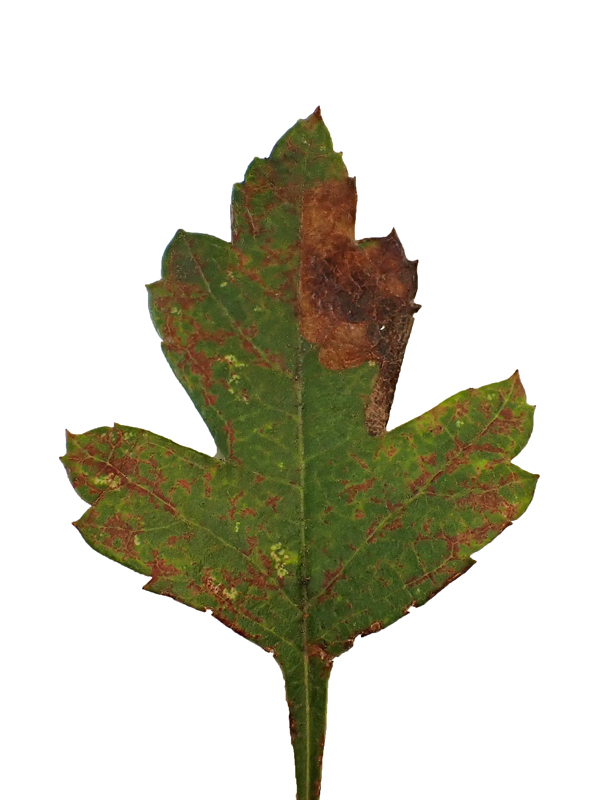
This is a Phyllonorycter oxyacanthae mine on Hawthorn:
Amongst other species I found on Hawthorn was Ectoedemia atricollis,
like this example:
I initially thought this might be Stigmella paradoxa, but the egg position was
not right and as can be seen there is evidence of a gallery leading into the
blotch.
I found a few mines on Rowan. These folded leaflets, along with the smaller
pinched in mine on a leaflet above, are the work of
Parornix scoticella:
However, along with Lyonetia clerkella that mines everything, the other mines
I found on Rowan were species that I've only previously found on Hawthorn:
Phyllonorycter corylifoliella
Stigmella oxyacanthella
Other mines that I found on what may be thought of as atypical foodplants
included:
Phyllonorycter leucographella on Malus sp.
(alongside Lyonetia clerkella on the plant it should be found).
Here's a couple of other mines for reference:
Stigmella salicis on Salix sp.
Tischeria ekebladella on Quercus sp.
One last mine, this one though from the Silver Birch in my garden:
Phyllonorycter ulmifoliella
That's probably enough mining for now, and I've realised looking through that I needed to crop some of the pictures a bit tighter. Never mind.
I guess this post isn't the mining Public
Service Broadcasting were thinking of.
Over the last couple of days whilst out looking for leaf mines, I've stumbled
across a number of powdery mildews. A couple I recognised, others I've just
ignored in the past and one I've never noticed at all. Most of the following
are quick phone snaps, but you get the gist.
A couple of the more obvious ones were these:
Erysiphe alphitoides [Oak Mildew] on Oak
Sawadaea bicornis [Field Maple Mildew] on Field Maple
The next few have almost certainly been seen before but ignored:
Erysiphe heraclei [Umbelifer Mildew] on Hogweed
Golovinomyces sordidus [Plantain Mildew] on Greater Plantain
Neoerysiphe galeopsidis [Mint Mildew] on White Dead-nettle
But this one I'm sure I've not seen before to be able to ignore it. On a Salix
sp., with both sides of the leaves affected and colourful cleistothecia on the
underside of the sample leaf I collected. Seems to be
Erysiphe adunca [var adunca]. As you can gather from the above, these
mildews have very inventive common names and it will be no surprise to hear
this one is known as Willow Mildew.
All of this would have been right up Seth's
gata if he was still on blogger, just like this Swedish metal.
I have just two records of Merveille du Jour from the garden - singles
c9 days apart in 2009, none before that and none since. The lack of mature
oaks within sight of the garden will not help. So, when I potted one up from
the trap last night I was well chuffed. Even more so when I found another in
the trap this morning - albeit that one was missing antennae for some reason.
What a marvellous start to the day ....
Most of the rest of the autumnal stuff that has turned up over the last few
days is brown or grey.
Beaded Chestnut
Juniper Carpet
Red-line Quaker
Satellite
Acleris sparsana
Feathered Thorn
Dark Chestnut
Green-brindled Crescent
I did get out today looking for more leaf mines, and found a good selection
along with a few mildews, rusts and galls. A lot of it sorted and ready to add
to records but still plenty to go at.
It's been a busy and strange few weeks in a lot of ways, but not least the
fact that our youngest has buggered off to Bristol and is living in Uni digs
whilst starting his degree in (literally) rocket science. We nipped down to
check he was set-up okay a couple of weeks ago, but otherwise we're adjusting
to not having him here and having a room in the house that is not being used.
Our other two still live at home, but both work and both spend as much time
out with their partners and mates as at home. It's pretty much the first time
in 26 years that we've been able to do what we like, when we like, without
having to plan around one or other of the kids. We're not used to it and
haven't really capitalised on that yet!
The garden works are done and I've got a new bigger shed to sort out, along
with some drainage that works well and a level patio. A lot of work ahead to
actually make it look presentable and get some flowering plants in, and I've
got space at the bottom of the garden for composting. I also intend to create some
sort of raised pond - something for inverts, not amphibians!
One or two of you may well have noticed that I've not really mentioned or
shared anything about my 2021 square listing. I've not consciously given up,
but since July-ish it has pretty much drifted to the point that I may as well
have done. I've struggled to maintain enthusiasm and am short on energy whilst
being busy back at work. I also got well behind with transcribing garden light
trap lists to keep up to date. Through September I've barely had time to even
think about it. Yesterday I was in work tying up a few bits before I have some
time off in the coming week. On the way home, I took a detour along the lane -
the first time I've driven along there for a few week. The verges had been
mowed and the fields harvested, so not a lot to look at. But I did nosy around
at the trees and hedges for leafmines, finding quite a few on Ulmus, Norway
Maple, Field Maple, Hawthorn, Blackthorn and bramble.
A while ago, when I was expecting to be a bit more enthused and busy in the
field, a bought a cheap LED panel off of Amazon -
this one. I figured that for around a tenner it was worth a punt to backlight
leafmines with a bit more consistency and less pfaff than anything else I've
tried over the years. Powered from USB and A4 sized it is also very light and
portable. But - I obviously didn't read the blurb or look close enough at the
images. I thought it would just be a lit screen but it has a built in eye
protection plate - essentially when it is fully lit it looks like a load of
perforations. Still perfectly good for backlighting mines, but not so great
for photographing them. So I put it back in the box and forgot about until
yesterday evening when I had a bag full of mines. I gave it a go and,
actually, I'm quite happy with the results - albeit I need to edit the images
a little more in photoshop though it really is quick and easy for me to do
that.
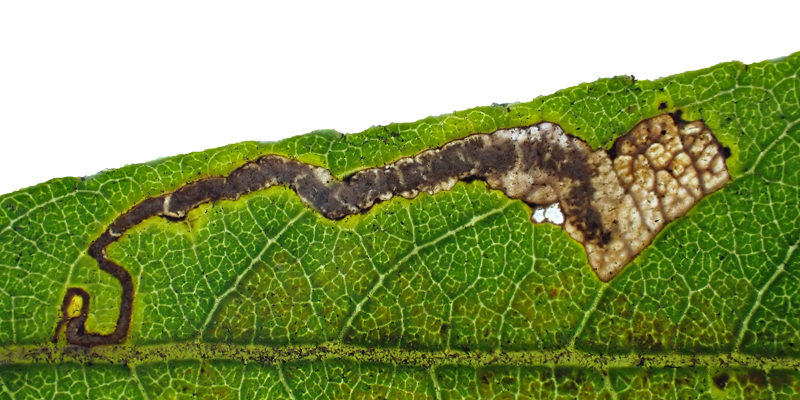
Here's an example - a Blackthorn leaf with
Stigmella plagicolella mines. The first image is directly off of the
camera with no editing other than being re-sized. The second is the same image
with the background screen cut out and otherwise my usual editing (light
balance, sharpen a little and crop/resize).
I found quite a few Stigmella plagicolella mines on one particular Blackthorn -
it's about the only one that is set beck enough from the road that it doesn't
get quite so heavily flailed and so it has bigger leaves. Some were still
tenanted, and one leaf in particular had many mines - at least eight, probably
more.
I was also pleased to find Stigmella aceris on both Field Maple (first
image) and Norway Maple (second and third image, alongside a
Phyllonorycter joannisi mine).
The Ulmus sp. mines were most numerous though, with many Stigmella mines -
some of which I could not work out but a few appeared a bit more distinct and
I sought a bit of confirmation on the leafminers FB group to help make my mind
up. The few tenanted mines were a bit more straightforward, with only Stigmella lemniscella
still active out of the two species I had. I also found a couple with the
distinct concentric circular start to the gallery.
Other mines were more consistent with Stigmella viscerella, showing a
winding 'gut-like' pattern to the gallery and a slightly different frass
pattern.
I found two different Phyllonorycter mines on Ulmus sp. - one a bit more
pinched than the other. Several had pupal cocoons within the mine which made
ID straightforward. The first mine has the dark stiff-looking pupal cocoon of
Phyllonorycter tristrigella, and the second is
Phyllonorycter schreberella with a neater and more delicate looking
spun cocoon
Also found on Ulmus was this Bucculatrix albedinella mine.
Other mines found were Stigmella aurella and Coptotriche marginea on bramble,
Phyllonorycter corylifoliella on hawthorn and Parornix finitimella on
Blackthorn. Given I was only looking for c45mins I though that was not a bad
effort. With some time in the week before we go away for a family break next
weekend, I'll be looking for other mines and perhaps a few galls.
The garden trap has been on for a couple of nights, so I will have a few late
autumn moths to share at some point too.
Hmm. That felt quite good getting that done and ready to post - perhaps the
post-summer doldrums are over and things are getting better.