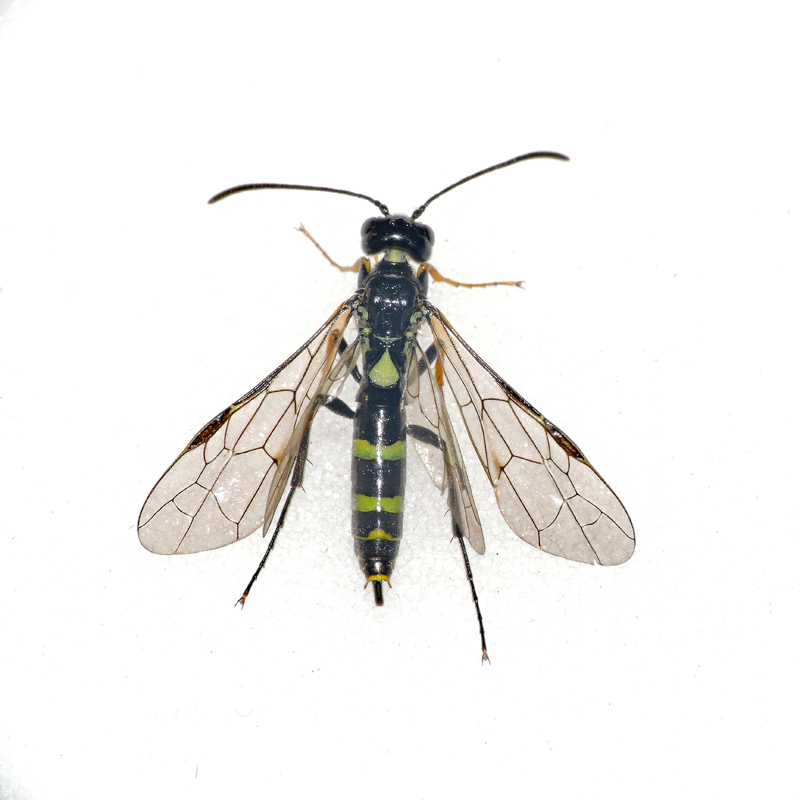
Remember I mentioned that I nipped out for a walk on Sunday afternoon, after a day of heavy showers. I took no net, but managed to pot by hand a selection of diptera, sawflies and one ichneumon from umbelifer flowers. Turned out to be a bit of pot(ting) luck in all respects; of the six specimens that I selected for pinning, five are new to me. One of those may even be new for VC55.
I can't claim any credit for the ID of this Tachinid, I had a wild guess and Chris Raper promptly put a better name to it ......
This is Linnaemya picta, only added to the British list in c2008 and has been spreading with a big surge in the last year or so. Can't see any dots for VC55 on NBN Atlas maps ....
Some of the facial bristles are key to separating from Linnaemya tessellans.
The other dipteran tick was this small-ish hoverfly, Riponnensia splendens. The facial dusting, metallic bronze thorax and dull mat stripe along the abdomen, along with size at c7mm, separate it from similar species.
A couple of sawfly ticks were these ....
Arge melanochra
Hind femur black and black smudge at the stigma not across wing help separate from the ubiquitous Bramble Sawfly (Arge cyanocrocea)
Cephus pygmaeus
Antennal segments thickened towards tip, bifid claws, hind tibia dark (not yellow) help separate it from Cephus spinipes
Finally an ichneumon that looks great, like many do, only to find it could be one of several species. However concensus reached that it is Ichneumon suspiciosus based on antennal characters, notably the antennal tyloids on segments 7 to 15.
This morning I got up and out early, intent on enjoying some nature on my last day before going back to a more normal work-leisure pattern. I had already decided that I was going to head to Ketton Quarry to try and photograph some butterflies, with the aim of arriving before they were too active. I also wanted to check out the Hornet Moth colony.
When I got up to empy the moth trap, there was a bit of a foggy haze but it had every sign of clearing to another warm day. As I drove east it stayed the same, then as I turned north from the A47 to head towards Ketton it started to look decidedly more cloudy. I pulled up alongside the Poplar Trees and check the trunks - no sign of any Hornet Moths ....
As I walked around, I started to wonder if my plan was doomed as the cloud cover persisted and nothing was active. I did expect it to be quiet to start, and trying to get butterfly photos is a trade off: early in the day they are less active giving better photography chances, but less active butterflies are much harder to find. It paid off in the end, as both my targets were found and photographed whilst still docile enough to stay still as I approached.
My main target was Dark Green Fritillary. I have seen them before, but I've never bothered to look for them in VC55 in the last few years since they've arrived and colonised. However numbers this year have been ridiculous and it seemed daft not to make the effort.
The other target was Marbled White, one I've seen many times but they're not usually easy to get a good photo of.
The only other butterflies I pointed the camera at early in the morning were these ....
Meadow Brown
Ringlet
Later in the day, after it had warmed up considerably, Dark Green Fritillary was easily the most abundant butterfly on site, closely followed by Marbled White.
Once there was more activity, a couple of big lumbering Silver-washed Fritillaries were seen but neither came close enough for more than a record shot ...
I was stood a good 15 meters away from this butterfly!
After a quick coffee, I headed back to the Poplar Trees. Still no sign of Hornet Moth as expected; they usually emerge early in the morning and have disappeared into the canopy soon afterwards. However I went prepared and hung out the HOR lure. This is reportedly not very successful, but I've only used it once - at Ketton Quarry a few years ago - with success. I was soon being bombed by x3 males. I managed to grab a couple of quick shots as one landed on the tree trunk, but it's not as good as catching them freshly emerged (and inactive!).
Hornet Moth
But my best find of the day was a rare form of a common moth that I've not seen before:
Round two with the new (un)improved editor interface ....
Today has been very sultry: warm, humid and a few torrential downpours. I had
intended to get out but after a lazy post-trap lie-in I had two false starts;
just as I was about to leave the rain came down like monsoon season. By the time
it stayed dry it was late afternoon, so I opted for a walk down the lane. No
net: it's pointless sweeping vegetation after rain as the net gets knackered.
However I had a bagful of pots and managed to collect a variety of sawflies and
diptera just by hand-potting them from umbelifiers. It wasn't exactly the most
efficient method, but successful enough. The specimens include a large
tachinid-looking fly that I think will be new to me.
The moth-trap was again busy, but I definitely missed out on a new beetle ....
This Helophorus sp. was massive compared to the usual trap-visitors - a
fact that I overlooked and completely forgot about after going through the
rest of the egg boxes so the specimen was chucked out with the rest of the
catch. It's either H. aequalis or H. grandis - both equally likely in a garden
trap in Leics. They can be separated from features on the last sternite
apparently, so I definitely need to remember about this if another turns up.
I potted up a variety of moths to photograph for a change. Selecting which
moths to point the camera at is arbitrary: anything new to garden obviously,
anything unusual for the garden likely, but beyond that it's just what I feel
like bothering with.
Elephant Hawk-moth
Burnished Brass
Figure of Eighty
Dusky Brocade
Ingrailed Clay
Small Dusty Wave
Single-dotted Wave
Teleiodes vulgella
Both of the following are, I'm sure, Notocelia trimaculana. I have no
doubt about that personally, but there was a recent suggestion that this and
Notocelia rosaecolana cannot be reliably separated. I think that may be true
for worn specimens, but I reckon differences in the costal strigulae and
general size and tone (smaller/dark vs larger/bright) will still be good. For
the moment though there is a need to build up a pattern so both of these, and
perhaps a couple of others through the season, will be gen detted.
Sheesh. Blogging is going to become a real chore at this rate. Once again post created in twice the time it normally takes, labels applied painfully one-by-one after saving as draft, only to then have an error with labels that prevents publication. I've also noticed that the ability to force images to higher res (?) is perhaps missing - need to look at that in more detail. Revert to legacy - publish fine.
Although as it happens from Tuesday I am back at work, actually in the Factory away from the 'home-office' (I was off on Monday anyway as this weekend we were supposed to be enjoying beer, cheer and music at the Isle of Wight Festival). At the start I was clamouring to be in the workplace; after enjoying the lockdown garden wildlife and local forays I'm starting to wish I was retired .....
After an early trap-emptying session (with a lot more moths than of late, though nothing exceptional) the day has mainly comprised of cracking on with painting fence panels, seeing as it was dry and warm. Not a lot seen whilst doing that, but I did notice quite a few bits dithering around the gardening waste bin which have probably come from some lilac branches cut off yesterday. I also found a new for me larva. So, here's a mix starting with some hoppers .....
These two were amongst a handful in the trap this morning:
Ribautiana tenerrima
I reckon this is Oncopsis subangulata, but both this and O. flavicolis occur together on birch so I'll need to grab a couple to check out.
And this was on the gardening waste bin during the day ....
Common Froghopper
Also knocking about on the gardening waste bin were these beetle larvae:
Harlequin Ladybird
Ten-spot Ladybird
However this larva was a bit of a mystery. It's clearly a sawfly, but I found it resting on the side of the shed not really close to any plants. The gardening waste bin was nearby, and I wondered if it had come from there with the ladybird larvae. As the bin was mainly full of lilac cuttings, I stuck the larva in a tub with a leaf but it wasn't interested. So I stuck in a range of leaves from the back garden, and as there were also clippings from bushes on the front I stuck those in too. Still nothing. I then stuck in a leaf from our small Lycesteria formosa bush which is also on the front, though none of that went in the bin. Immediately it started eating and has already eaten half of the leaf. I guess it must have got knocked off and swept up somehow, but aside from some larval feeding damage I couldn't find anymore larvae on the bush.
This is one of the Abia spp., which may need to be reared through to confirm to species.
At this point, I'm going to mention that I've created the post with the new Blogger editor, and it is wank. It's going to take a bit of getting used to, and rather than being more intuitive it feels like a real slog. In particular, adding labels efficiently is a mystery and I had to revert to the legacy editor to get it to publish without a label error message. Good luck!
Here is something from some better Editors.
When this here blog first started, most PC set-ups could not handle web-page widths of more than 800px wide. Within a couple of years, 1024px wide web-page widths were typical, and then they started getting bigger. In the early years of blogging I fannied about with the layout a few times, and I also used to highlight some species names in a colour - which was fine until I changed the layout and page colours subsequently. But one layout change, sometime between 2009 and 2010, ended up making some earlier posts a jumbled mess and from that point I was reticent to make any significant change.
Gradually image sizes increased, and I also got used to ensuring that the layout was uniform by editing the html. For a long while now I've stuck with a layout where the images were set to 600px wide for display and the actual images larger - typically up to 1200px wide and very occasionally full size. Of course these days most users have full HD monitors capable of 1920px wide, but I have carried on assuming that anyone interested would 'click for big' to see a larger image anyway.
Today I've taken the plunge and found that in the intevening years a feature was added to the layout editor which allows the same 'theme' to be maintained whilst allowing the blog page width and side bar width to be set. So I've tweaked it. This will allow future illustrated posts to have displayed images up to 1000px wide. It will mean that everything that's gone before will look like there is lots of blank space either side of the images, and there will be a few where there seems to be a huge gap between some text and the associated image as I have always ensure images are centered. It might also mean posts look like I've not written much (which usually I haven't, but the same words on a wider page makes it look like there are even fewer!).
Having a capability to display larger images is fine for most landscape aspect ratios, but probably not for portrait 3:4. However today I've also discovered a little bit of html coding that allows images to be put into a table so images can be displayed alongside each other. If anyone is interested and able to work with html, the coding is this simple bit (just cut and paste to replace the red text with your own image headers and image file data):
<div style="text-align: center;">
<table style="margin-left: auto; margin-right: auto; text-align: left;"><tbody>
<tr align="center"><td style="text-align: center;"><div style="text-align: left;">
<b>PHOTO A HEADER TEXT</b></div> PHOTO A
</td><br /><td><div style="text-align: left;">
<b>PHOTO B HEADER TEXT</b></div> PHOTO B
</td></tr>
</tbody></table>
</div>
Very occasionally, I go back and edit an older post to make it more readable or presentable, and if so I'll edit the displayed image size where possible. As I've got bugger all else to post today, I have gone back and edited posts from this month to show/test the new layout. And these are some random images from Exmoor Zoo in April 2015 to show the new size and show smaller images can be tabulated.
POST-SCRIPT Having looked at it a few times I think I overdid it, so I'm going to reign it back to 800px wide images (ie c33% bigger than I started, rather than c67%).
I guess what I need to know very quickly is whether these changes create problems for anyone accessing this blog - let me know!
Dull, chilly and windy today. But at least there was a let up in the showers, enough to tempt me out to Watermead CP North to see if I could manage a snap of a Red-necked Phalarope that turned up yesterday and was still present this morning. I did, but it was not easy with the conditions and the fact that most of the time when it was in view it was too close!
It spent most of its time feeding very close to the shoreline, but it was gradually working northwards and kept disappearing behind reeds and in amongst overhanging trees before popping up again in the next open bay. At one point it suddently decided to head out into the open water, and then had a brief fly about heading back south. It was not high so I doubted it had gone, but after half an hour of searching the southern end there was no sign - only for it to pop back up again on the bank-side of one of the bays.
Here's a few shots. I have many more that are no good for one reason or another - but mainly due to the bird being active and being moved about by the wind at the same time so lots of out of focus or half-a-bird shots.
One travelling lister shows how hard it was to socially distance from the bird.
The bird is also in this phone snap of the statue of a King Lear scene.
Other birds included a superb Hobby, a Little Egret, loads of House Martins and Swifts with fewer Sand Martins, Common Terns and a few singing warblers. There were plenty of damsleflies sheltering from the wind in the reeds too. Apart from the phalarope though, I didn't point the camera at much else.