Birds, Leps, Observations & Generalities - the images and ramblings of Mark Skevington. Sometimes.

Tuesday, 6 April 2010

Migrants & Moths

I enjoyed two brief forays with bins today. A lunchtime jaunt to Thornton Res. provided nice views of singing Willow Warblers (3) and a spanking drake White Wagtail in the regular field - no sign of any Yellow Wagtails though whilst I was there. On the way home from work, I dropped past Grove Park for a quick peek and was really pleased to see a diminutive wading bird that has used the site in the past. I thought they were long gone from this site so good to see though time will tell as to whether any success this year.

Is it just me, or has all of the Blackthorn suddenly sprung to life over the last couple of days?

The garden moth traps last night produced another yeartick, but the windy conditions limited numbers despite the mild temps. 16 of 8sp. was the total (125W MV 10 of 8, 80W actinic 6 of 3).

0663 Diurnea fagella 1
0667 Semioscopis steinkellneriana 1 [first for year]
1524 Emmelina monodactyla 1
1746 Shoulder Stripe (Anticlea badiata) 1
2187 Common Quaker (Orthosia cerasi) 3
2188 Clouded Drab (Orthosia incerta) 2
2190 Hebrew Character (Orthosia gothica) 6
2243 Early Grey (Xylocampa areola) 1

Diurnea fagella - a darker form with a rubbed right wing

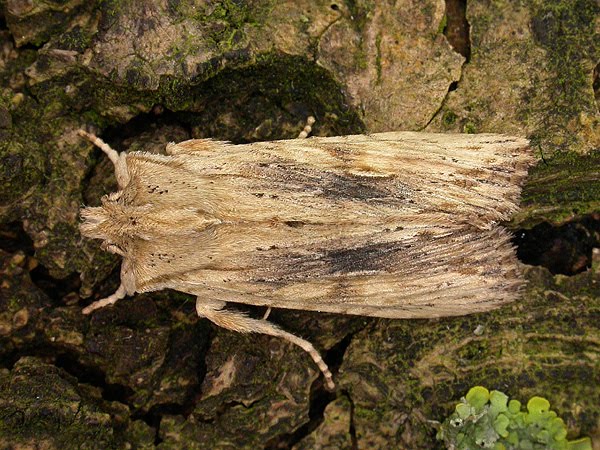
Semioscopis steinkellneriana - a classic example of why vernacular names are useful ...

Just off out for a bit of local woodland mothing seeing as the conditions look good.

Monday, 5 April 2010

Pseudo & Psychidae

I had really fancied a bit of blatant twitching over this weekend, but seeing as the Lesser Ketrel inconsiderately fecked off before Friday I couldn't be arsed with travelling to Suffolk/Essex/Kent just to see Pallid or Alpine Swift - I've not seen either in Britain due to considerable lack of effort and having never twitched either, but have seen both abroad.

With nothing else worthy of travelling for, I inevitably spent the day out pseudo birding in Leicestershire with family in tow. I suggested we have a good walk all around Beacon Hill as it would be much less busy than similar sites.

Turned out to be a good choice - a peaceful walk in fresh air without having to tolerate hoards of ignorant tossers. Sadly, the birds were also pretty thin on the ground. There were plenty of Chiffchaffs singing, but no Willow Warblers and no Wheatears anywhere. Nice to see and hear common species getting busy though, including Jay, Nuthatch and Great Spots.


In a scene reminiscent of the appalling Bill Bailey bird-spotting based pile-o-shit, the kids decided to build a 'hide'.

Alex adds the finishing touches

Whilst they did that, I busied myself with this:


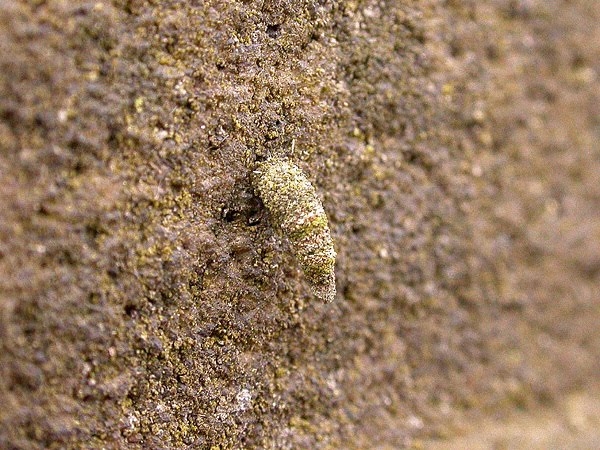
Lichen/moss covered dry stone walls are superb places to check for psychidae - surely the most bizarre group of moths bar none. Within seconds I'd found several Narycia duplicella cases, all c6mm long and apparently inhabited.


I've reared this species before, and the fully winged adults are quite smart so I collected a few to have another go. I also found a small Common Footman larva, only c15mm long - probably only just starting to feed up after overwintering.


We spent a good few hours at Beacon Hill, and spurred by the stone wall success I insisted we go home via Swithland Reservoir.

Along the causeway, as usual, there were 100s of inhabited larval cases of the parthenogenetic apterous form of Luffia lapidella (f. ferchaultella) - what a mouthful. The larvae live in their cases for c9 months before pupating within the case, emerging as a wingless female which promptly lays viable eggs within the case and dies. The tiny larvae set about making their own cases after hatching and the cycle starts again. No males involved. I can't see it catching on.


From Kinchley Lane, I picked up plenty of Swallows and Sand Martins low over the res (c40 of each). No sign of either Taleporia tubulosa or Psyche casta cases, so I carried on to the dam and set about potting up a few Dahlica spp. cases to try and rear through. We have both D. lichenella and D. triquetrella in the same section of wall. Again these are both apterous and parthenogenetic. They can only be reliably separated by microscopically assessing the number of tarsal segments or the pupal head-plate - hence potting a few to check.


Some of the mosses on the dam wall were 'flowering' - probably.


Tomorrow looks to be the best day weather-wise for a while - fecking typical as I'll be back at work!

Pale Surprise

Ran the traps last night despite the forecast. As long as it is not actually raining before dark it's worth a go. It was actually clear and cool, though rain moved in overnight and this morning was cold, breezy and damp. The total catch was a poor 8 of 4sp. (125W MV 6 of 4, 80W actinic 2 of 2). However it was all worthwhile when I spotted a Pale Pinion sitting on a slab next to the MV.


First for the year and first in the garden for six years. I had a brief run of spring singles in 2003, 2003 & 2004 when this was still a very scarce species in VC55. It's still scarce, though both it and Grey-shoulder Knot have increased markedly in the same time that Tawny Pinon has declined.

2187 Common Quaker (Orthosia cerasi) 2
2190 Hebrew Character (Orthosia gothica) 3
2236 Pale Pinion (Lithophane hepatica) 1 [first for year]
2243 Early Grey (Xylocampa areola) 2

Saturday, 3 April 2010

I've Got Crabs ..

.. but before that, here's a summary of garden mothing last night.

Very cool, heavy rain shortly after dark, clear and breezy by early morning. As you'd expect, these are not ideal conditions for mothing. Total catch was a modest 16 of 5 sp. (125W MV 8 of 5, 80W actinic 8 of 4).

Shoulder Stripe (Anticlea badiata) 1 [first for year]
Common Quaker (Orthosia cerasi) 8
Clouded Drab (Orthosia incerta) 3
Hebrew Character (Orthosia gothica) 2
Early Grey (Xylocampa areola) 2

Shoulder Stripe - not the smartest individual but nice to see one in the garden, albeit a bit later than usual

Haven't bothered with the traps tonight - it started raining again just before dark and it's likely to be cold. Over on the right hand side I've added a couple of links to 2010 mothing yearlists for the garden and everywhere - I'll update monthly.

As for the title .. remember we set up a tropical fish tank a few weeks ago? Well we started adding a few fish gradually, and the kids also wanted a couple of these after seeing them in the aquarist:

Red-clawed Crab (or at least that's what  think it is)

As for the fish - nothing too fancy, all basic stuff to start with. The tank also has live plants and a big piece of bogwood - not sure if that is a good idea though as despite the pre-soaking it still turns the water a bit sepia between water changes. Trying to photograph anything in a large water-filled round tank is ridiculous.

High-Fin Blue Platy

Red and White Platy

Swordtail

Guppy

Top Mothing Nights

Following one of Ben's comments, I had a trawl back through my records to see what the top nights have been in my garden traps in terms of both numbers of species and numbers of individuals.

I've run a 125W MV trap of one sort or another since 2000, and in 2007 I also started running an 80W actinic. The following are the top nights so far:


I think I'll need to retain a few micros for dissection to beat 112 species in one night in the garden, whilst the 615 individuals in one night is largely down to the late summer noctuids (especially Large Yellow Underwing which seems to really go for the actinic).

I've also looked back at out of garden trapping, both solo efforts and joint sessions with others, and the best out of county nights (though these are all at Wicken Fen despite trapping at Dungeness, Gibraltar Point, Portland, Durlston, Hazleborough Wood and Old Sulehay).


6438 of 276 species is going to take some beating anywhere, and 3192 of 233 species from just 6 traps is also highly notable.

Thursday, 1 April 2010

This week, I have mostly been listening to ..

The still-excellent debut release from Leicestershire's finest ..